【It is always dark before dawn, and after the darkness, the dawn will surely be seen.】
【It is always darkest before the dawn, and after darkness, you will surely see the light of dawn.】 Casual Talk on Investment CLEC Investment and Financial Education Academy Blog Post Date: February 23, 2022 I have been in the market for over 30 years and have witnessed countless market downturns. Usually, during market declines, the emotional changes of investors follow these steps: 1. The market is very excited: A few key stocks hit new highs, everyone is relatively optimistic about the market, and doesn't believe the market will fall. In the investment group chat, everyone chats
【Before dawn, it must be dark; after darkness, you will surely see the first light.】 Casual Talk on Investment CLEC Investment and Wealth Management Education Institute Blog Post Date: February 23, 2022
I have been in the market for over 30 years and have witnessed countless market downturns. Usually, the process of investors' emotional changes during market declines follows these steps:
-
The market is extremely excited: several benchmark stocks have hit new highs, and everyone is relatively optimistic about the market, not believing that it will fall. In investment groups, everyone talks freely about individual stocks and the future, each person having their own opinions. Everyone thinks they are a stock guru, and each person can eloquently present various reasons for price increases and personal unique insights about the market and individual stocks, completely ignoring the existence of the market itself, believing they can control the market and that they are the stock guru who understands the market best. At this time, the predicted high points for stock prices become even higher, and some firmly believe that the market will not fall; if it does fall, they will buy more, or it is even impossible for them to think that their high-performing stocks could drop by 90%, which creates an objective environment for a market peak and a subsequent decline.
-
Excessive confidence of investors during market up and down phases: When the market begins to drop by 10%, many people start to believe that the market will quickly rebound after a deep fall. When the market drops to a critical support level and begins to rebound, all investors start feeling optimistic. Some begin to increase their positions, while those who sold at the high points also start buying at this time. More leveraged investors are buying as well. There will definitely be investors who completely ignore our warnings that funds from pledged loans should not be invested in the market, and borrowing should not exceed 20%. If pledged loans exceed 20% and the market falls, your mood and mindset may not hold up. The same applies to investing three times in TQQQ; investors with poor psychological resilience taking excessive risks may now already feel the pressure. Remember, stock-pledged loans must never be reinvested in the market and should never be used for reinvestment during market declines. This behavior can bankrupt investors. If you have not carefully followed our past repeated warnings, you may need to reduce your positions during market declines to avoid the risk of ultimate bankruptcy.
In the second phase of this market decline, investors generally do not believe that the market will fall any further. Many investors confidently say that even if their individual stocks drop 90%, they would never sell. We recommend that everyone sell individual stocks and move to the index fund QQQ, but almost no one is willing to do so. In fact, this makes me even more worried about the market. With everyone so confident, based on my past experience, the market will continue to decline under such conditions. In my over 30 years of experience, a market drop of just 15% will not stop there, but how much further it will go, I do not know. In any case, those who try to guess the market will not have a good outcome. The market will severely punish those who are overly confident. A few weeks ago, I advised everyone to sell individual stocks and move to the index fund QQQ, but it seems that I may be the only person actually following this advice.
-
The Main Decline Phase of the Market: Today, February 23, the market broke through the support level and fell rapidly and sharply. This indicates that the market has begun to panic, and those who were previously overconfident have started to waver. On February 22, 2022, the Soviet Union recognized the two Eastern Ukrainian regimes, claiming that peacekeeping forces would enter the Eastern Ukrainian region. The market dropped significantly, and the day ended with a doji candlestick, leading many investors to believe that the market might have bottomed and would rebound. However, the market dropped even more the next day, suggesting that the market had probably already started to panic. As for how long this panic will last or how much further the market will fall, no one knows. At this time, many investors holding what they considered high-quality stocks or risky assets began to waver in their mindset. We then watch for when these people will sell off. Only when these originally overconfident investors, in this subsequent rapid decline phase, lose confidence and irrationally sell their holdings does the market have the chance to bottom. But for long-term index investors, there is no need to panic at all, because what you are investing in is an index fund that will always rise in the end, unlike individual stocks, where someone might start doubting whether the risky assets they hold could ultimately be worth nothing. I am not describing this to scare anyone; I just want everyone to remember not to be overconfident. Overconfident individuals are actually the most ignorant investors in the market.
-
The final decline phase of a panic-driven stock market: The market will absolutely end after panic selling, so long-term investors must remember not to sell your index funds at this point. Investors with available capital should bravely buy during this decline. Those holding too many individual stocks, especially if a single stock makes up a large portion of your portfolio, and you have begun to lose confidence in that stock, at this time, you can reduce your individual stock positions and move to index funds (although it may be a bit late), which is an unavoidable strategy. However, it is not possible to avoid the situation where, when you sell to move into index funds, the market starts to reverse upward, and you might miss out on gains from your individual stocks. But if the market really continues to fall and your individual stock drops by 90%, you would regret it deeply. Such a result is absolutely due to your initial overconfidence. All investment mistakes are never caused by the market or others; the sole responsibility for any investment error lies with the investor themselves.
At this time, individual stock investors will start thinking about or imagining all kinds of terrifying events related to their stocks, ultimately leaving them in panic. After this market correction, everyone must review the changes in their mindset during this process. Market fluctuations are the single best opportunity to train investors and improve investment qualities, gradually transforming oneself into a high-quality long-term investor. The market has now fallen 19% from its peak, and there is extreme panic here. I want to tell long-term investors: you must not panic, and even more importantly, you must not sell the index funds you hold.
- The darkness before dawn will surely see the light: When everyone experiences a rapid and significant decline in the market, there is bound to be extreme panic. When both you and the market are in extreme panic, the market bottom should be right there. At this time, everyone must return to the essence of investing: investing involves long-term growth and short-term fluctuations. Short-term market declines and large drops are perfectly normal, while long-term growth is inevitable. During such a major drop, only investors in index funds can enjoy the natural market fluctuations. Because investing in index funds does not involve individual stocks, there are no 'monsters' appearing, and you do not have to worry about any single stock dropping to zero. The market will eventually reach a bottom, rebound, rise, and eventually hit new highs. Short-term market fluctuations are natural, and long-term growth is inevitable.
Remember that it is always dark before dawn, and after the darkness, you will surely see the first light of day.

More Posts

Chapter 58 [Investment Philosophy] - Successful Investors
Our cognition of external things is entirely based on past experiences. This experience and scene will continue to exist in our hearts. Whenever we see highly similar external things, although they are completely different from the past, we will combine them with our inner cognition and think that they are the same. For example, a person who is extremely afraid of dogs will be afraid even if he sees the tamest dog in the world, because he will regard the docile dog on the outside as the same ferocious dog that once bit him inside. So, in the past

Chapter 73 [Wisdom of Stock Trading]
This is a lifetime summary of stock trading written by a person who has been stock trading all his life. There are different ways to invest, and in the end you will know that you can make money in the market! (You can graduate.) Master the timing, money management, and emotional control. The four stages of stock trading (you can definitely survive after graduation): ㄧ. The reckless stage: (Tao Tingtu said) 80% will die here. 2. Exploration stage: (Read a lot of books and know how to stop losses.) Always stop losses and do all futures and options that can be traded in the market.
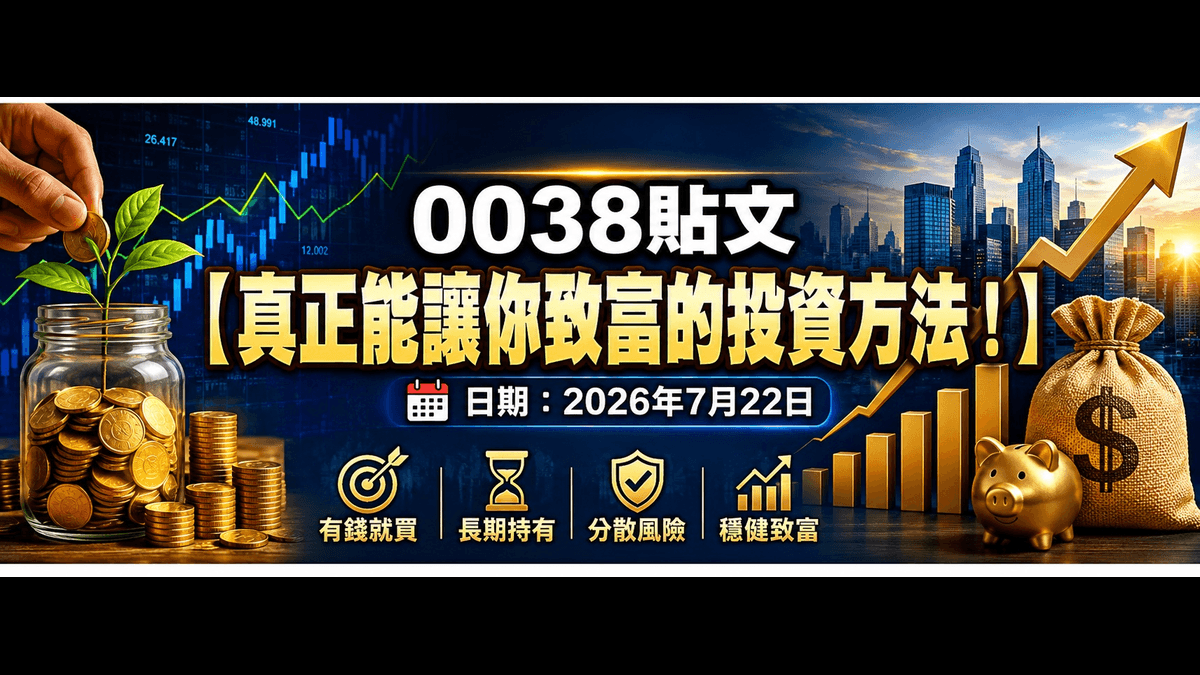
The Investment Method That Truly Makes You Rich!
Beating buy-and-hold is not about timing or forecasting the market: buy a U.S. broad-market index fund the moment you have money, buy at any time, and never sell. Waiting for a low usually costs more than buying at a high.
Newsletter
Join the community
Subscribe to our newsletter for the latest news and updates