Chapter 4 [My first ten years of investing (ignorance)!]
The first stock in my life The first time I held a stock in my life was Acer's stock. At that time, Acer's stock had just been listed. As long as you worked for one year, you could be allotted two stocks, each with 1,000 shares of Acer stock. At that time, I had no idea about the significance of stocks. I only knew that I could exchange them for cash by selling them. Finally, because I was young and had just started working, I wanted to buy a car, so I sold two Acer stocks (they were still selling at a relatively high point at the time), exchanged them for nearly 230,000 in cash, and bought a Yulon Su
Source document: 2022.02.04第四章【我投資的前十年(無知)! 】.docx
Source: https://www.facebook.com/794648900700097/posts/2135381963293444/
[The Origin and Today of James] Chapter 4 - My first ten years of investing (ignorance)! (02/04/2022)
My first stock in life
The first time I held a stock in my life was Acer's stock. At that time, Acer's stock had just been listed on the market. As long as I worked for one year, I could be allotted two stocks, each with 1,000 shares of Acer stock. At that time, I had no idea about the significance of stocks. I only knew that I could exchange them for cash by selling them. Finally, because I was young and had just started working, I wanted to buy a car, so I sold two Acer stocks (they were still selling at a relatively high price at the time), exchanged them for nearly 230,000 in cash, and bought a Yulon Sunny. This was my first experience of investing in stocks. I didn’t feel it at all. It seemed that the company’s allotment of shares was part of my salary, and the purpose was to convert it into cash and spend it. Think about it, the original NT$230,000 was nearly US$7,000 or US$8,000. If invested in the US market, it would be nearly US$150,000 now, which is not a small amount. But life is about doing what you want when you want.
I see the Acer stock chart from 2,000 years ago to today when the stock price has lost half of its value. If annual dividends are included, people who have invested in Acer for 20 years may not have made any money in the long run. At most, the annualized return is a little more than 1%, which is similar to a fixed deposit. This is the risk of investing in individual stocks. We really cannot determine the future prospects and investment returns of a company. This is why ordinary investors should never invest in individual stocks, because in the long run, your rate of return will not be better than that of passive index funds. If you invest in the US passive index fund QQQ, the annual return rate from the high in the past two thousand years to now (2022) is 7.5%. Moreover, if you invest in passive index funds, you will never need to sell them and they will not go bad (index funds will automatically eliminate weak ones and replace them with strong ones). In the United States, you do not need to sell stocks or pay capital gains tax. Index investments can continue to compound interest without performance impairment. And individual stocks will go bad one day, either you have to sell, or your children and grandchildren need to sell. In addition, many people will have questions. If you invest in index funds, you will never have to sell them. If you don't sell them, where will the money come from? We have recommended on many occasions that you pledge your stocks and borrow money to spend them. We will explain the details in a separate chapter in the future.
I invest in HTC stocks
I remember that in 1999, when HTC was selling for about NT$300-$400, I started buying HTC shares. I knew that HTC seemed to be doing pretty well in making mobile phones, but I actually had no idea about the mobile phone industry and the future of mobile phones because I was still using them. AT&T's most traditional mobile phone can only make calls, and it doesn't even have the ability to send text messages, so I have no sense of smartphones. I have no feeling at all. Moreover, I saw some people holding smartphones as if they were holding a brick to their ears to talk. I thought how could such a product sell well? Besides, at that time, you also had to use a stylus, which is a tool that I find difficult to use. Even so, I still think it's because HTC is the king of stocks. , I thought it would rise (follow the trend), and I called my classmate. For this matter, I even asked him to meet at the Taipei 101 coffee shop. I told him on the spot that high-priced stocks are bought by rich people, so you must buy them (only afterward did he tell me that he bought HTC because he heard me say "rich people buy them." This is how retail investors invest.), so this classmate ignorantly bought HTC shares with me. I also think that I understand investing and stock speculation. Really very ignorant to some extent, most of all investors are ignorant, or do not know they are ignorant at all.
Those who don't know their ignorance usually go bankrupt. Some people who can't make money by investing alone turn to investment teaching, either because they don't know that they are ignorant, or else they are liars.
At that time, I was still speculating on stocks, so when HTC rose from $300 and $400 all the way to $1,200, I bought more all the way. This is what the so-called ignorant investors call "momentum investing" and "trend investing", some high-sounding terms that deceive others and themselves. It feels noble to use these advanced terms to cover your own ignorance of investment skills.
Later, when HTC fell from $1200 to $1100, I informed my classmates to sell (the so-called breakout of support), and the market continued to fall to more than $900. Later, it reached $1000, and I bought again (the so-called breakthrough pressure). Of course, it later fell below $900. 900, this time I exited the market with a loss (the so-called stop-loss exit), and notified my classmates to sell. After that, I never touched HTC again. In other words, just like ordinary retail investors, it was a completely mindless operation, but the whole process also made a profit (many investors are in In the end, I bought the car with more than $1,000, but I didn’t know how to sell it later, so I lost money and went bankrupt). Fortunately, I don’t do this often. If I continue to do this, I will not be able to retire early, let alone write such an article here and say such things to everyone ( He may be so poor that he cannot speak), and of course it is impossible to teach investment and lead everyone for more than ten years (investing in peripheral commodities is more profitable than investing in it. There are people in Taiwan who teach investment in a class of hundreds of thousands, hundreds of thousands, hundreds of people attend, and earn 10 to 20 million Taiwan dollars in a class. Of course it is easy to make money.
Many so-called teachers charge tuition to teach investment. I would say that these teachers’ charging tuition has proven that they have failed in investing. Don’t believe that such teachers can teach investment anymore. Teachers who can truly make money will not charge tuition.
Without experience in investing in funds, it is not recommended to invest in active funds.
Since coming to the United States in 1990, all my investment experience has been in the United States. Ever since Frank taught me how to buy funds, I started buying funds. I didn’t know what fund I bought at that time. I remember buying OAKMX. I heard that it was a fund with good performance, and then they launched another fund, OAKBX (Balanced Fund), but after I bought it, it actually started to rise. This was thanks to the initial stage of the Internet bubble, but I don’t know if this rise meant it exceeded the standard (I didn’t know about the index at all at the time. I only knew the Dow Jones Industrial Index at that time, and I didn’t know that my investment performance needed to be compared with the index). In short, my investment at that time was simply ignorant. Looking back now, the performance of these two funds is very poor. SPY grew ninefold during this period, while one of the two funds quadrupled and the other only tripled.
At that time, I was very obsessed with researching funds. I went to Charles Schwab every month to get the Fund Selecting List (Fund Selection Manual). Looking at the types of funds, there are growth types, value types, and balanced types. At that time, I didn’t even know that there were raw materials and other monster funds. I was very obsessed with the research at that time. I looked at the medium and long-term return rates of each fund and studied them seriously. I often bought magazines to read the performance rankings of funds. I spent a lot of time and bought everything at random, thinking that I already knew a lot about fund investment. To put it bluntly, looking back now, I was actually fighting with ghosts. I didn’t know that I was ignorant.
From the past experience of investing in general active funds and the experience of several active funds we have recently invested in, when the market is good, it is okay, but when the market is bad, the decline is much larger than the index, and the beta value is very high! The volatility is high and the performance is worse than passive funds. Damn it. This is a ghost fight between active funds (until the beginning of 2022, we also discovered that the four major active funds we recommended a few years ago, although they performed very well in the past, fell at the end of 2021. The index fund QQQ fell 16%, and these passive funds fell 30%. No matter how good the active funds are, they still can't beat the market) and they have learned to stay away from active funds. Some active funds may outperform index funds in the short term. In the long term, almost no active funds can outperform the market. This is why I still recommend that you stay away from active funds and not invest in any active funds. Everyone must insist on investing in the US passive fund QQQ.
Ignorant individual stock investment experience recommends investors not to invest in individual stocks.
From 1990 to 2000 in the United States, I invested in funds and found that the return rate was too poor. Individual stocks seemed to rise faster (in fact, this was a wrong feeling. Individual stocks were more active, but investing in individual stocks by myself may not outperform the market index in the long run), so I started investing in funds. I started buying individual stocks. At that time, in the early days of the dot-com bubble, everything was going up. All high-tech stocks would go up if you bought them. This was the bull market without a master. Everyone seemed to be a stock market expert. Finally, at the end of the bubble, almost everyone thought he was a stock god. Everyone can talk about a few booming stocks. At that time, we also had business cooperation with several high-tech manufacturers, such as 8X8 and ESST. After 25 years, 8X8 (EGHT) has a return rate of only 55% and an annualized rate of return of only 1.6%. The return rate is far lower than that of government bonds and lower than that of fixed deposits. Next is ESST. This company may no longer exist. I can't find the stock of this company.
At that time, I was completely ignorant when buying and selling stocks, and I didn’t know how to read financial reports. Even though I cooperated with them, I thought I knew about the company, so I bought their stocks without knowing whether they were good or bad. In fact, at that time, the products of these two companies had almost no sales, and they did not understand the so-called EPS (earnings per share), EPG (earnings per share growth), let alone the return on equity (ROE). Without understanding anything, they dared to buy and sell for tens of thousands of dollars. The handling fee for a single transaction of investing in stocks back then was as high as $49. How could you make money as an ignorant retail investor? You are lucky that you did not lose all your money. I still remember that I was often concerned about the stock market. Sometimes in the middle of a meeting, I would come out and use a traditional telephone to place an order. Even on a business trip, at the airport or at the COMDEX SHOW, I would often use a public telephone to trade at any time. This is the common ignorant behavior of many retail investors (or they think they are very powerful, but in fact they do not know that they are ignorant). During the company lunch, several colleagues had lunch together, and they probably discussed stocks.
Therefore, ordinary investors invest in individual stocks more casually than grocery store people. They usually end up with losses because they hardly understand the analysis of individual stocks, and they are even less able to predict the future prospects of individual stocks. Frequent trading is simply suicidal investment, and is actually no different from mentally ill patients (usually if you tell a mentally ill patient that you are mentally ill, they will not accept it. Therefore, gamblers in the market all think that they are gods, but in fact they are worse than fools). Therefore, it is strongly recommended that you do not invest in individual stocks and do not operate frequently (you should not operate at all. Operation is capital suicide). You should still use the U.S. market index as your investment target. Only in the long run can you be invincible in the stock market. Learn from Buffett and become the world's richest man.
Another suggestion for everyone, although passive index funds are good investments, there are still some differences between passive index funds. Passive index funds also include large technology stocks, large conventional stocks, world index funds, world high-tech funds, emerging country index funds, European index funds, Asian excluding Japanese funds, small stocks, and mid-cap stocks. I can't finish it even if I write a few pages. So there are already a dazzling array of passive index funds, as well as balanced index funds, bond funds, and raw materials funds... I suggest that you do not invest in small and medium-sized index funds. From a long-term historical perspective, the performance of small and medium-sized index funds has not been better than that of large index funds. This is because the proportion of small and medium-sized companies that really perform well is not high. When they grow to the main growth stage, they will be included in large index funds such as QQQ and SPY, so you can regard large index funds as successful companies. Collectively, small and medium-sized index funds are immature companies, and the probability of failure is very high. Therefore, for investors who invest in small and medium-sized index funds, you will share in the failure and loss of most companies. However, after a few companies succeed, they are moved to large companies and have to be removed from the small and medium-sized indexes. When they become successful, you will not have a share. This is the shortcoming of small and medium-sized prime number funds.
In addition, I do not recommend investing in index funds in Europe, Asia and emerging countries. We need to know the entire global production and supply chain. The most valuable is the United States, which is driven by innovation and consumption. The United States is based on its locomotive status in innovation and consumption, followed by Asia's manufacturing and export industries. Innovative industries and brands are the industries with the highest gross profit and the most lucrative profits. OEM industries in Taiwan and Asia are usually manufacturing and export industries with low gross profit. Although TSMC's gross profit has reached very high, there is only one company. When you want to buy the entire Asian index, or the Taiwan index, TSMC only accounts for half or less at most, but TSMC's gross profit and rate of return It is not as good as the top ten companies in the United States, so the return on investment in emerging countries such as Taiwan, South Korea, and mainland China will not be higher than that in the United States. Then there are the upstream raw material countries, the Soviet Union, Brazil, India, and China, which were previously known as the BRIC countries. Finally, because of the bubble in 2008, their performance was very poor. Therefore, in the entire supply chain and innovative industries, the United States is still the first choice for investment.
In addition, the biggest problem in the stock markets of emerging countries is the issue of institutional management. The investment stock market in the United States is fair, just, and open. If you have insider trading, the FBI will definitely find you. You can escape for a while, but you cannot escape forever. But the market system in emerging countries is different. Company hollowing out abounds, and insider trading is even more frequent. You simply cannot make a profit in such a market. That is to say, don’t invest in emerging countries. Even if Taiwan’s system is becoming more and more complete, hollowing out and insider trading are still quite frequent. There are very few cases that will actually be brought to the table for judicial processing. Moreover, Taiwan also has many systems that are conducive to ways for major shareholders to hollow out companies.
Next, there are very few innovative industries in Europe. If you point out ten of your fingers, the United States accounts for at least eight of the world's top ten innovative and profitable companies, China accounts for two to three, and Europe has half of them. Therefore, Europe is a relatively backward desert region in terms of innovative industries. There is also the European tax system and labor protection. The system is almost more socialist than socialism, so European investment profits are taxed first, and then workers are protected. In the end, almost no profits can flow to investors. This is why I do not recommend investing in Europe. Based on the above analysis, only the American index funds QQQ and SPY ( My first choice is QQQ), which is the only target that investors can consider investing in.
Therefore, everyone must only invest in large-scale passive index funds QQQ and SPY in the United States. This is the essence of investment and the summary of Buffett's investment spirit. As long as you buy and invest in large American index funds and never sell in long-term investments, this is a necessary condition for successful investors. There is nothing else but the only one.

More Posts
Stop Sacrificing Your Life to Save $1,000 a Month: After Doing the Math, I Realized How Foolish It Was
The comparison shows that saving an extra $500 or $1,000 per month may barely change retirement timing, while making life too tight.

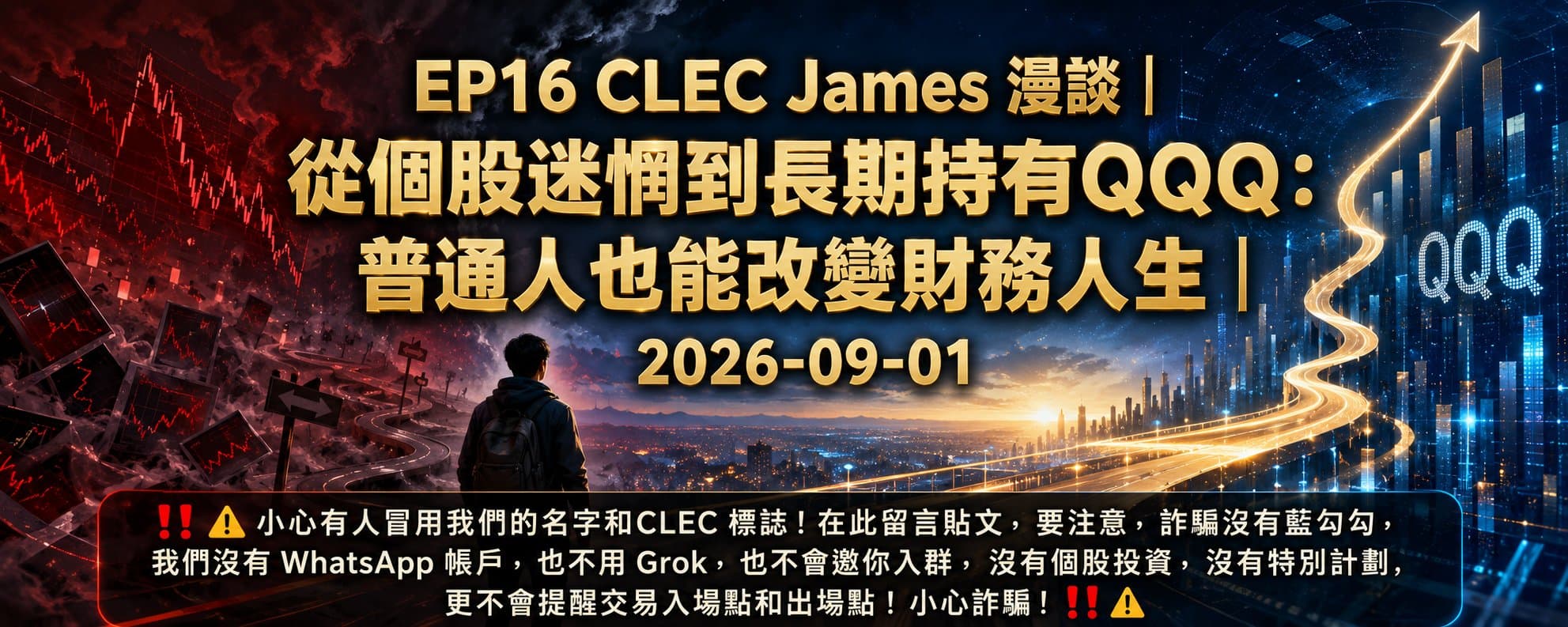
從個股迷惘到長期持有QQQ:普通人也能改變財務人生
CLEC James 漫談第16集:從個股迷惘到長期持有QQQ:普通人也能改變財務人生
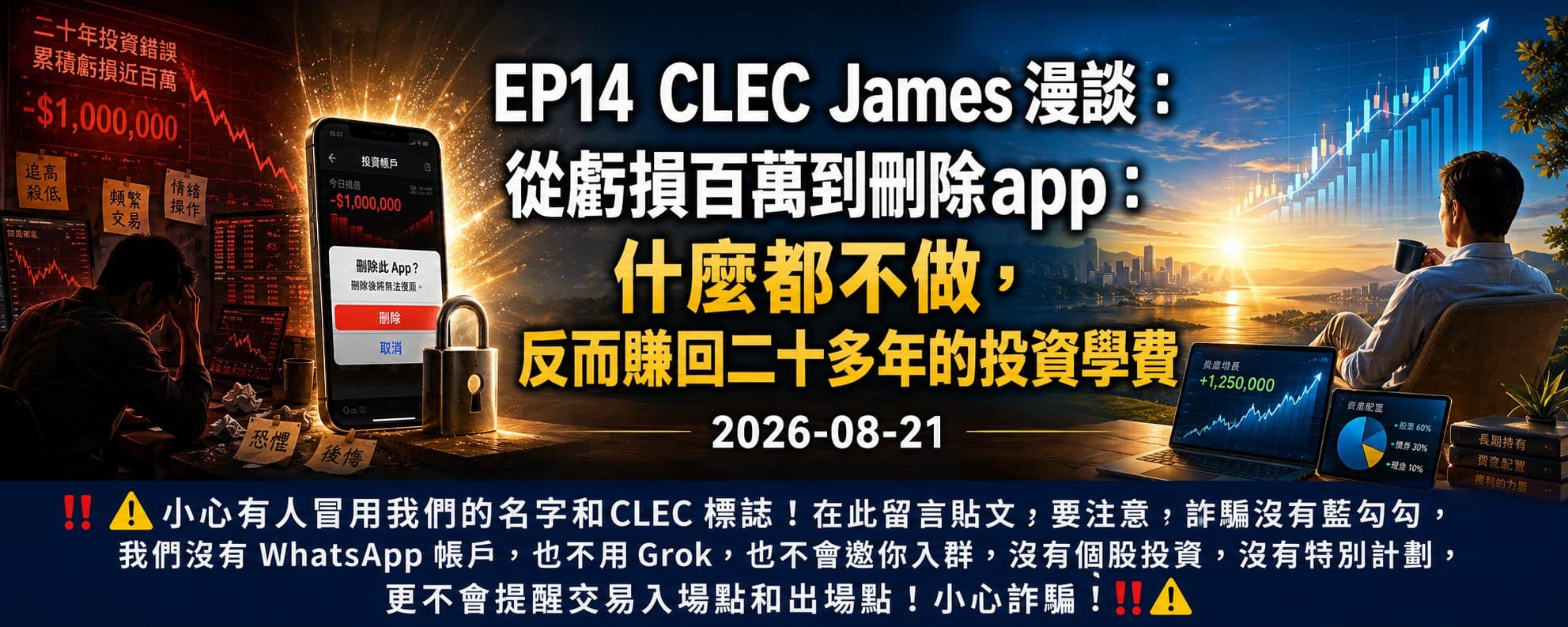
From a Million Lost to Deleting the App: Doing Nothing at All Won Back Twenty Years of Tuition
Episode fourteen of CLEC James Talks: a friend spent over twenty years taking detours and paid close to a million in tuition, going from fixed monthly investing to dividend stocks, shipping stocks, and a volatility ETF. After completing his asset allocation he sealed the account for a year, did nothing at all, and recovered almost all of it. The real test is not the rise but the next fall.
Newsletter
Join the community
Subscribe to our newsletter for the latest news and updates