
The Ultimate Value of Money and a Free Life Built on Asset Allocation
Episode three of CLEC James Talks: trading money for convenience and good relationships, a clear separation of the 2%, 3%, and 20% figures across the working, retired, and single-pledged-loan cases, and finally throwing off the shackles of money to take back control of your life.
Hello everyone, I am James. Welcome to episode three of "CLEC James Talks." Today I want to talk with you about what money really means in life, the practical thinking behind retirement asset allocation and stock-backed borrowing, and how to enjoy the convenience and freedom money brings in daily life.
https://open.spotify.com/episode/6U58jfXjZXibgV0co5OGRA?si=h2KVZux3RaG7YjbOTOngqQ
1. Trading Money for Convenience in Life and Good Relationships
In fact every one of us can have a very rich life. If there are things in life that can be "solved with money," that is actually the cheapest and most worthwhile way to solve them.
If spending money can buy you convenience and efficiency in life, then you should spend generously to buy that convenience; and if spending money can sustain good relationships with family and friends, or make those relationships better, then that money is very much worth spending. Because in the end, if money is never used, what is left is merely an inheritance.
As long as you have worked out that your retirement provision is sufficient, or that what you have saved is already enough to cover your future retirement needs, then the surplus you have now should be used to buy present-day quality of life, convenience, and good relationships with people.
2. Channel Interaction and a Note About Comments
Regarding the podcast and Spotify platforms, I have now turned off direct comments. From now on, all posts and discussion about new episodes of "CLEC James Talks" will be announced in one place, on X (formerly Twitter). If you have any thoughts, replies, or topics you want to discuss about the show, you are welcome to come over to X and leave a comment any time.
3. Clarifying Retirement Withdrawal Rates and Stock-Backed Borrowing (the Difference Between 2%, 3%, and 20%)
Recently some newer friends watching our videos have found it easy to confuse the numbers behind "stock-backed borrowing," "withdrawing 2% or 3% a year for living expenses," and "a single loan must not exceed 20%." Let me sort these out again here:
1. Working Employees (Accumulation Phase)
Emergency fund: If your employment income is stable, keeping 1 year of living expenses as an emergency fund is enough; the rest can all go into the market (such as QQQ).
Those using leverage: You can use a 433, 622, or 811 allocation. For example, with 622 (20% leverage, 20% cash), as long as that 20% cash covers more than 1 year of emergency reserves, there is no need to hold any additional cash.
2. Retirees (Withdrawal Phase: 2% and 3% Withdrawal Rates)
80/20 allocation (80% QQQ / 20% cash): You can withdraw 2% of total assets each year for living expenses.
70/30 allocation (70% QQQ / 30% cash): If you want more money to live on, you can withdraw 3% of total assets each year.
Those needing a higher withdrawal (such as 4%–5%): If your required withdrawal rate exceeds 3% (for example, 10 million in assets with 500,000 of annual spending), it is advisable to add a high-dividend ETF (such as QQQI). Put 12 years of total annual expenses (that is, 12 times annual spending, e.g. 6 million) into QQQI to generate cash flow, and allocate the remaining funds (4 million) using 80/20 or 70/30. Preparing as much as 12 years is to build a margin of safety for when dividends shrink in a falling market.
3. Single Large Expenses and Stock-Backed Borrowing (the 20% Ceiling)
"A single loan must not exceed 20% of assets" is a risk-control principle for cases where you need to borrow a large sum at once (such as a first car purchase, a house down payment, or an urgent medical need):
Buying a car: It is better to use an auto loan first, then take small monthly draws through stock-backed borrowing to pay the installments, rather than pledging one large sum of cash to buy the car outright.
Buying a house / large needs: If your assets are 10 million, the ceiling for a single pledged loan is 20% (that is, 2 million). After borrowing 2 million, you must adjust your allocation: first put twice the borrowed amount (4 million, i.e. 40% of total assets) into a money market fund to reduce leverage risk, then allocate the remaining 6 million at 70/30 or 80/20, and make your regular withdrawals (2%–3%) from that remaining allocation.
4. Making Good Use of Taiwan's Medical Resources and Regular Screening
Taiwan's national health insurance system and medical services are very convenient. I would urge women in particular to have regular mammograms and cervical smear tests. Every major hospital has a service desk for free regular health checks (including fecal occult blood tests, mammograms, smear tests, and so on); you do not need to register and see a doctor for a referral first, and you can book at the desk directly or arrange a screening the same day. This is basic health protection provided by the government, and everyone should make good use of it.
5. Throwing Off the Shackles of Money and Taking Real Control of Your Life
Freedom in life increases gradually as your personal financial position is built up. As long as you have worked out that your retirement funding is properly prepared, the rest of your money does not all need to be locked away in retirement planning.
Life does not begin at the moment you retire; it began at birth, from the day you started earning your own living. Many people are excessively frugal, spending a great deal of time comparing prices in the supermarket (comparing rice prices, comparing oil prices, and after checking price-comparison sites, going out of their way to switch stores). This actually puts you under the control of money, creating enormous mental pressure without your noticing, and can even lead to autonomic nervous system problems.
As long as you have stable work and a financial plan, then when you walk into a convenience store, PX Mart, or Costco to buy what you need for daily life, you should be able to "buy it if you need it." That is respect for your own life, and it is the most basic and most important freedom that money gives us.
‼️⚠️Beware of people impersonating our name and the CLEC logo! Note when leaving comments and posts: scammers have no blue check, we have no WhatsApp account, we do not use Grok, we will not invite you into a group, we do not do individual stocks, we have no special programs, and we will certainly never tell you entry and exit points for trades! Watch out for fraud! ‼️⚠️
Author

Categories
More Posts
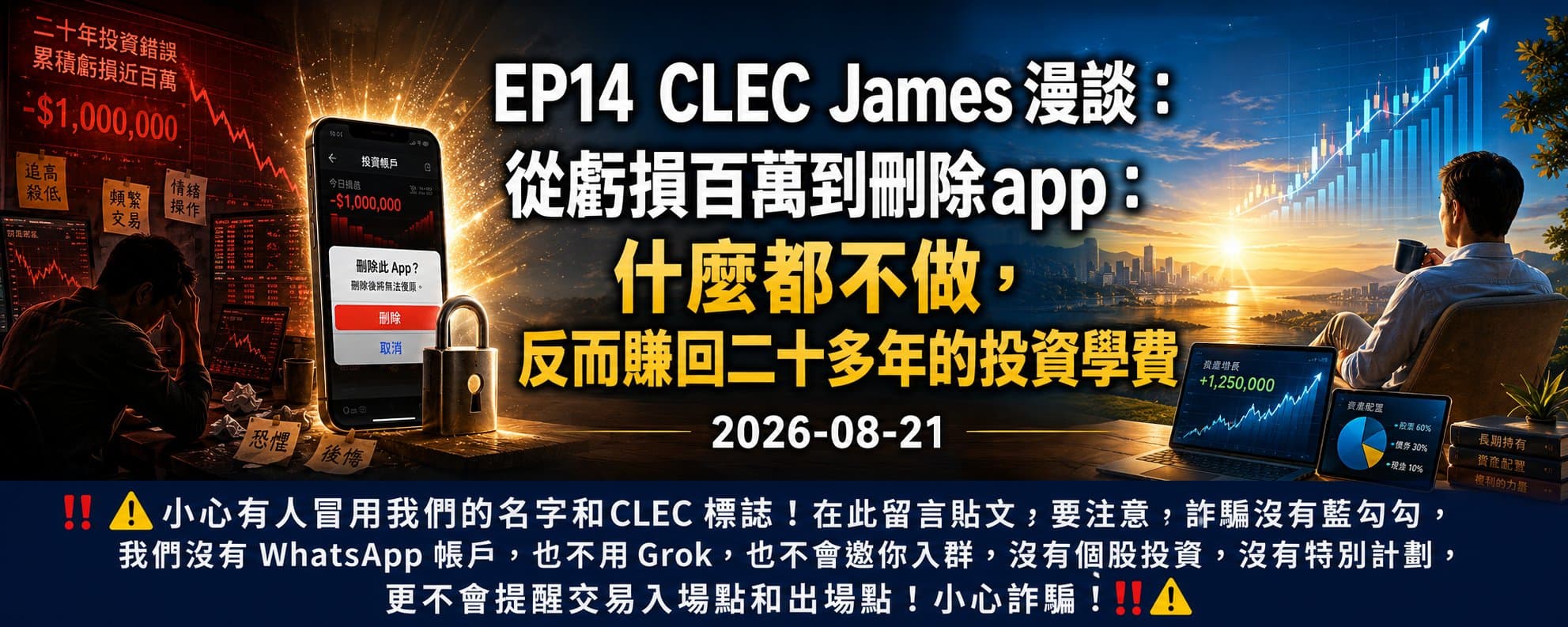
From a Million Lost to Deleting the App: Doing Nothing at All Won Back Twenty Years of Tuition
Episode fourteen of CLEC James Talks: a friend spent over twenty years taking detours and paid close to a million in tuition, going from fixed monthly investing to dividend stocks, shipping stocks, and a volatility ETF. After completing his asset allocation he sealed the account for a year, did nothing at all, and recovered almost all of it. The real test is not the rise but the next fall.
Small Group Meeting Q&A (8)
Small Group Meeting Q&A (8). Written on August 26, 2018. Question eight: Are Apple Pay, Square, and PayPal competing with one another? These three mobile payment businesses are completely different.
![Chapter 42 [The Market is the Best Teacher!]](/_next/image?url=%2Fimages%2Fblog%2Fjames-history-and-today%2Fen%2Fjames-history-and-today-0048-cover.png&w=3840&q=75 "Chapter 42 [The Market is the Best Teacher!]")
Chapter 42 [The Market is the Best Teacher!]
In the investment market, there are a lot of people who will predict the market, there are a lot of well-meaning people who will tell you that now the market is going to fall again, it will continue to fall, it will fall to the floor, and then there will be the basement, and there will be 18 floors underground. How panicked you are! But usually the louder that sounds, the closer the market is to the bottom (but, remember, we don't predict the market). After the market has fallen sharply, even Buffett began to say that the value of the US market has emerged, Buffett has begun to buy,
Newsletter
Join the community
Subscribe to our newsletter for the latest news and updates