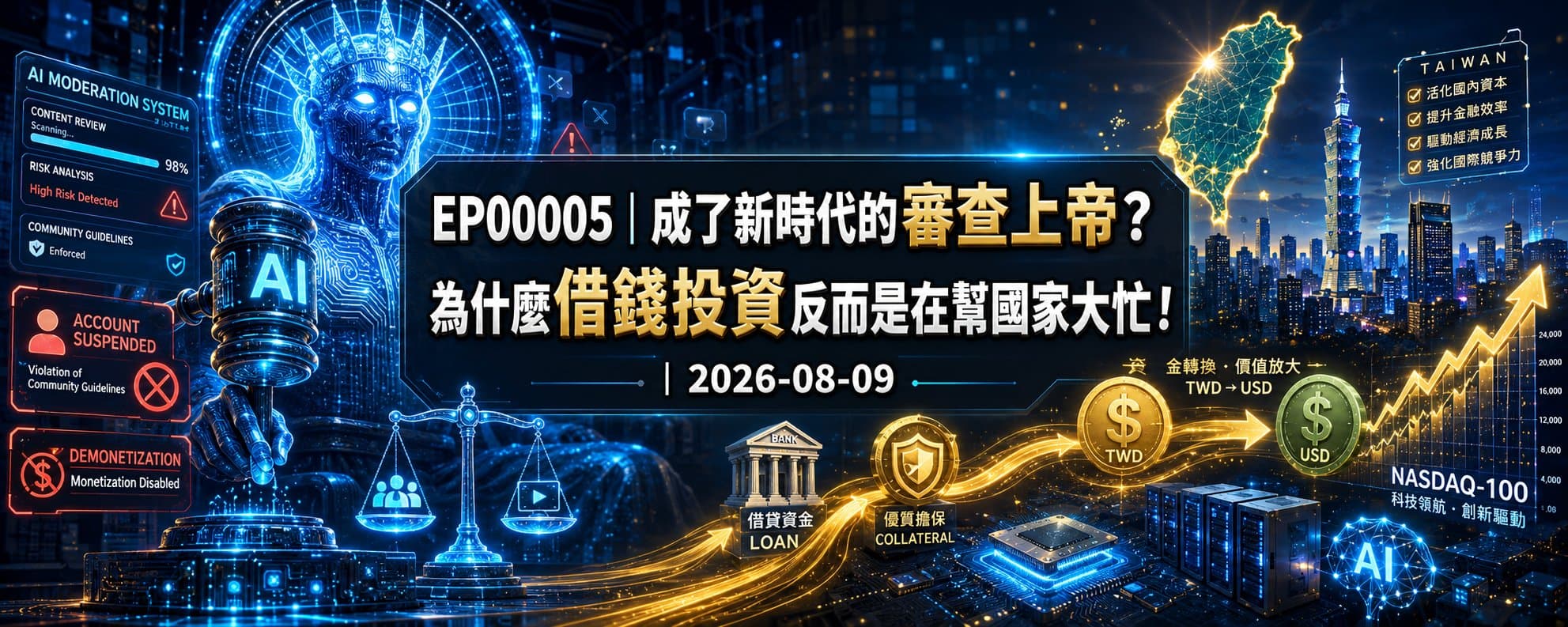
Have We Become the Censoring Gods of a New Age? Why Borrowing to Invest Is Actually a Great Service to the Country
Episode five of CLEC James Talks: platforms now moderate by AI, which means every sovereign state gets its own "god"; plus why a low-rate era has depositors subsidizing capitalists, and how Taiwanese investors borrowing to buy U.S. index funds put idle domestic capital to work and push the NT dollar higher.
"The Arrival of the Age of AI Censorship and the National Financial Contribution of Borrowing to Invest"
https://open.spotify.com/episode/4LVlxHg2juHxLjpyQcjtpH?si=T-gp_4sCS4iaz5Ge6KhGkg
Hi everyone, this is CLEC James Talks, and I am James. Today should be the fifth installment.
Today let us take up something I talked about last week, on Saturday I think: there are now many YouTubers and creators with one or two million subscribers who have nevertheless been suspended by the platform, to varying degrees.
Every internet platform and social platform now uses artificial intelligence to review content. This is rather like where AI has now arrived: besides doing many things for us, producing images and videos, and writing code, it may go a step further and become the AI reviewer for each platform. That means no human judgment is involved, no... it is as if you can be convicted without a judge hearing your case, and AI decides it directly. This is a kind of AI censorship, rather as if artificial intelligence is now playing the role of God.
Moreover, the artificial intelligences of different sovereign countries will be different gods; that is, their standards are not the same. So in future the one thing there will be no shortage of is AI gods. In other words, in the different regions we humans face, America has American standards; and American standards are of course the values Americans agree with, not necessarily the values the whole world agrees with. This is why someone like Jensen Huang now says every country needs its own large language model. Because you cannot use someone else's values to judge your own country's values! You would never bring in foreign judges to hold trials in your own country. But if you have no large language model, then in future many things will depend on other countries' large language models, and you will have handed over your own god to someone else.
This is what is developing now. Of course, for us it does not matter at all; it is all fine, never mind, because wanting nothing is what makes us strongest.
But think about it: some people run their own media or a YouTube channel that has reached several million subscribers, they depend on that channel for a living, and they may even have a production team. If they are suddenly banned from monetizing, or denied ad revenue, that is an enormous blow to those in independent or social media and pushes them into real difficulty. That is what is happening right now.
All right, next let us look at another matter: in any era, interest rates can be high or low. In a low-rate era, when rates are very low, as in Taiwan, and as during the subprime crisis or COVID-19, rates around the world fell to almost zero.
At such a time, a low-rate era is really depositors subsidizing the national economy and the capitalists who invest. Because you get no interest on your deposits, your money is taken and put to use; that is, the borrower, the person who borrows to invest, profits; and the state borrows, America issues bonds and borrows your money, you buy Treasuries, it borrows your money to spend, while your money is worth little because rates are so low. In a low-rate era, those who lend money to the state, or to industry, or to investors, are subsidizing the state and the capitalists of capitalism.
Only when rates are raised does the debtor, the wealthy, pick up the bill. Debt! Only then does debt, that is, this debt, for example if you lend money to the U.S. government at 6%, mean the government has to pay a great deal of interest to the people who lent it money. So a high-rate era is one in which the state and the capitalists are the ones paying, the ones picking up the bill.
So we, as capitalists who borrow, are actually helping to make the nation's assets more efficient. Especially in Taiwan: when friends in Taiwan invest in 00662 or in QQQ, the 00662 fund has to convert your New Taiwan dollars into U.S. dollars and go to America to buy the index. And when it takes that money to America to buy the index, converting NT dollars into U.S. dollars and remitting them to the U.S. exchange to buy QQQ, that action draws down Taiwan's foreign exchange reserves. That in turn makes the use of Taiwan's reserves more efficient. Otherwise the central bank will only take Taiwan's foreign exchange dollars and buy U.S. Treasuries, which in this low-rate era is subsidizing the American economy and the American government. So everyone who buys long-dated U.S. bonds is subsidizing the U.S. government, American companies, and American capitalists.
So borrowing to invest is helping the country: we convert the central bank's foreign exchange reserves into American assets, and that helps the efficiency with which the country's reserves are used. So I continue to encourage everyone: right now, whether it is credit loans, mortgages, or stock-backed borrowing, rates in Taiwan are still relatively low. This low rate is inefficient; rates have to be raised to become efficient. Let us see whether this can prod the central bank into raising rates, because only when the central bank raises rates will the country's capital be used efficiently. National investment is inefficient, because the central bank will only go and buy U.S. Treasuries.
Most citizens do not understand investing either, so they leave their money in savings accounts or buy time deposits, and that is all. So a great deal of Taiwan's money is just sitting in the banks. This is also why insurance companies say their greatest enemy is not people who invest in stocks; their greatest enemy, that is to say the people they want to attract, is the deposits sitting in banks. So insurance companies keep digging into the money of people with large sums in savings accounts, pulling it out to buy insurance, even having them mortgage real estate and urging them to buy insurance, and that is very inefficient. What they should do is invest the borrowed money in the U.S. Nasdaq-100 index fund. This has two effects:
The first is to activate domestic assets, that is, to activate capital;
The second is to buy American assets on the country's behalf.
So we investors, especially investors in Taiwan, really are doing the country a great favor. Investing in the U.S. index fund activates Taiwan's idle funds: there is too much capital, and it is because capital is abundant that rates are low; if capital were tight, rates would be high.
So the first thing is to push all of Taiwan's idle funds into the U.S. index fund;
The second is to raise Taiwan's interest rates so that Taiwan's capital is used efficiently. Borrowing to invest in Taiwan is nothing less than an enormous contribution to the nation's finances.
Everyone borrowing heavily stimulates a rise in Taiwan's interest rates, which indirectly strengthens the New Taiwan dollar, letting it appreciate, increasing Taiwanese purchasing power, and raising the economic value of Taiwan's export goods and human resources. So this is something to be proud of: do not worry about the interest rate on pledged borrowing being high. However high it gets, 4% is still very low, nowhere near as high as America's, right?
And why are American rates so high? Because they are not very willing to sell their own assets cheaply! Their rates are high and their currency is worth a lot, so what they buy from you is cheap. Because the dollar is strong, they buy your... your NT dollar is weak, so what they buy from you feels very cheap. But if the NT dollar could be pushed up, then they would have to buy expensive TSMC chips! And buy expensive Taiwanese AI servers! And our Taiwanese people's NT dollars could buy cheap imported goods from abroad.
So if the NT dollar appreciates, as I often say, if the NT dollar goes from 30 to 20, then a trip to Europe that used to cost you 150,000 might now cost only 100,000, because the NT dollar has appreciated from 30 to 20. So a Tesla that used to cost you 2 million might, if 30 becomes 20, cost only 1.4 million, less than 1.5 million, for one Tesla.
So everyone should know and understand that an appreciating NT dollar is good for Taiwan's economic development. Because our chips and our high technology, if the big American manufacturers do not buy from Taiwan, whom will they buy from? Even at higher prices they have to buy! Like memory, right: Micron's memory has a net margin of 70%, 75%, or 85%; their cost is only 15 and they sell it to you for 100. We should raise our prices too, but since manufacturers like TSMC dare not raise their own selling prices, dare not push prices up, the only way left is to let the NT dollar appreciate and raise prices that way, so the whole population benefits. So if the NT dollar appreciates, the economic value of our export goods and our labor rises, your purchasing power grows strong, and your national economy is the stronger for it, instead of selling your own country's labor and capital cheap.
Look at Sweden and Switzerland: how expensive the Swiss currency is, how high their rates are; that currency strength is exactly the advantage they enjoy.
So we investors who borrow to invest should feel very proud: we are doing something extremely beneficial for the country. And do as much of it as you can, provided your risk control and asset allocation are done well and your cash-flow chain does not break; borrowing then benefits both yourself and others.
OK, all right, let us stop here for today. See you tomorrow, bye-bye!
More Posts

You Do Not Have to Move
Monthly dollar-cost-average investors should not stop contributions during market declines. Long-term investors may also hold steadily through possible scenarios.

![Chapter 46 [The 1929 Great Depression: Causes, Process, and Results, Part 2]](/_next/image?url=%2Fimages%2Fblog%2Fjames-history-and-today%2Fen%2Fjames-history-and-today-0052-cover.png&w=3840&q=75 "Chapter 46 [The 1929 Great Depression: Causes, Process, and Results, Part 2]")
Chapter 46 [The 1929 Great Depression: Causes, Process, and Results, Part 2]
Modern mainstream economists saw the causes: a reduction in the money supply, bank crises, reduced credit, and bankruptcy; insufficient private-sector demand and insufficient fiscal spending; the passage of the Smoot-Hawley Tariff Act, which worsened what might otherwise have been a more standard recession; and insufficient spending, reduced money supply, and margin debt, which led to falling prices and further bankruptcy.
Who Benefits When Stock Prices Are High!
Who benefits when stock prices are high! A relaxed talk on investing from CLEC Investment and Financial Education Academy. Post date: May 24, 2021. Please share this article with investors around you so everyone can understand who benefits when stock prices are high.
Newsletter
Join the community
Subscribe to our newsletter for the latest news and updates