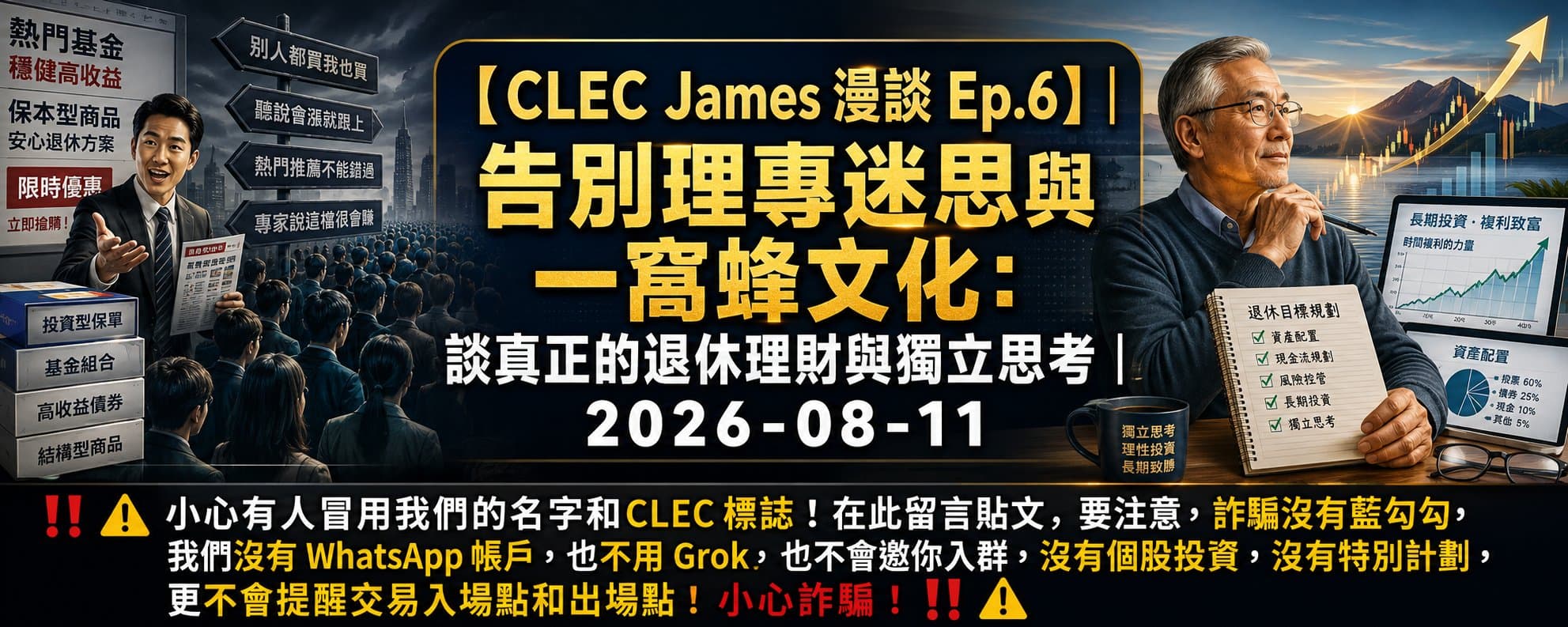
Leaving Behind the Adviser Myth and the Herd Culture: On Real Retirement Planning and Independent Thinking
Episode six of CLEC James Talks: a finance-industry wealth professional discovers after being laid off that he had no retirement plan at all; asking a bank adviser to plan your retirement is like looking for healthy food at a night market. Plus the educational roots of Asia's herd culture, and a real calculation for someone with 1.6 million in assets who wanted to borrow 8 million and retire.
Full transcript
Hey, hello everyone, this is CLEC James Talks, and I am James. Today should be episode six.
https://open.spotify.com/episode/5duqWeUkQeb9WbBa0ZeDxF?si=WrWWHldzT9-jqvTGTCRk6A
This morning I was listening to something on YouTube and happened to hear a financial media person in his forties who worked in the finance industry and was laid off in his forties. Only after being laid off did he discover in a panic that he had made no retirement plan at all and did not understand it himself. He worked in the wealth-management department of a financial firm, and yet after being retired he discovered that his own investment performance lagged far behind the market, and he was in real panic after retiring.
What this makes me think is that ordinary wealth-management advisers are actually selling products and have no idea at all what financial planning means. You cannot really blame them, because no one told them the truth, and they believe that selling products this way is helping people manage their money. They were never told, so you cannot blame them; it is like "being wealthy is a gift, being happy is a human right": if you were never told, you may have no way to realize it, and if you cannot realize it, how could you possibly say such a thing to someone else? Right?
So as for people in the finance industry, whether they came up through the academic track or have worked in it for a long time, they have been steeped in the whole capitalist financial industry and speak its sales language; and even those who came up through the academic track have never retired themselves. The professors who teach investing have never retired either, and only after retiring do they find out; those who teach investing and financial planning, or some professors, finance professors, are completely at a loss about their own investments and retirement plans when they retire, and do not know themselves what is correct. I have seen professors retire, finance professors retire, and still be utterly at a loss.
So let us not trust "expertise" too much. Real expertise is having been through it: once you have calculated and thought it through for yourself, you are the expert.
The fact that this professional in investing and finance was in such a panic after being retired makes me think of ordinary people who want to go to a bank and get an adviser to do their financial or retirement planning; that seems like going to the wrong place. It is like wanting to eat healthy food while spending every day walking around the night market, asking the stall owner what you should eat. Of course the night market owner will give you takoyaki, a pile of carbohydrates, a big bowl of braised pork rice, and so on. That is not so bad, at least better than going to a fast food place for fried chicken and fries; but if you think you are seeking a healthy diet that way, you have gone completely down the wrong road. So going to a financial adviser in the industry to do your financial and retirement planning is as impossible as going to a night market stall in search of a healthy diet.
The only person worth seeking help from is someone who is retired themselves, and whose own retirement plan has worked out well. I am not saying there is only one way; but the person you consult should be someone who retired long ago, whose money will never run out. Consulting someone like that might be useful. If the person doing your financial planning is only 30 years old, that is absurd. It is as absurd as a friend who drives a Mercedes asking someone who takes the bus or rides a scooter how to do financial planning.
All right, that is the first topic I wanted to share today.
The second topic is that education in Asia and in Europe and America is really rather different, and so are the cultures. Most of our friends in Asia put the group first: I do not want to be different from other people, I want to be the same as everyone else. Years ago, when we were children, what our fathers taught us was, "Why can't you study as hard as your older brother?" or, "Why can't you be as careful as so-and-so?" and so on. So we Asians usually demand that everyone advance together as a group, which means individual thinking gets suppressed and you end up with herd behavior. That is why Asia only does manufacturing, cutting prices... that is, competing on price cuts. This is a cultural tradition. In Asia... what we were taught as children was "without the country, how could there be a home"; that is what we were educated with as children. But education in Europe and America is not like that: their education says "without the people, how could there be a country." That is the difference.
I remember when I first arrived in America and went out to eat with American colleagues, we might have sandwiches, or go to Chipotle. One thing was of course the cultural difference: we did not know what the food was like. The second was that when Asians order, they usually say they will have the same as the person in front, or a group of Asians will all place the same order, ordering the same thing. But I watched my colleague, and however he... whatever he ordered would have been fine, but he simply would not order what the person before him had ordered. I said, "Hey, why don't you have the same as him?" He said, "No, I don't want the same." He could have anything else at all; he just would not be the same as everyone else. That is how genuinely different the habits of Westerners and Asians are.
And today I also saw something from Harvard Business School announcing the CEOs of Taiwan's top hundred companies, which amazed me, really amazed me. Of course this is not among the topics I had planned to talk about today, but let me mention it briefly. It amazed me so much: the average age of the CEOs of Taiwan's top 100 companies is 70. Absolutely incredible. Taiwanese people really do work themselves to the bone, Asians really do work themselves to the bone: the average age of the CEOs of the top 100 is 70. Wow, that is no small thing.
All right, that was another aside; it just came to mind.
Next there is an observation: in the past, some countries had relatively closed economies, so you could not buy goods from outside, could not buy cheap or good products. I remember when I went to the Soviet Union, their exchange rate was of course closed, and there was no foreign exchange, so they could not buy Western goods; what they wanted was to get dollars, U.S. dollars, so an underground exchange-rate economy was quite popular. So it was not easy for them to buy foreign goods, because their foreign exchange was not very... they simply could not buy things.
And now it looks as though America is keeping many good products out, good Chinese goods or cheap goods, solar for instance, plenty of cheap and good-value products, shut out at America's door; and America also seems to be pushing this kind of planned economy, supporting certain firms, in AI and in chips, which makes me feel that time has run backwards a little. Cheap high technology cannot enter America. Of course the stated reason is rather different, the reason is different: they cite national security. But it makes me feel time has run backwards a little. History does not repeat itself, but it always rhymes closely, and that is a very interesting observation too.
And next: yesterday, yesterday there was a friend; I remember his investment assets were only 1.6 million, he also had a credit loan, and he wanted to take out an 8-million mortgage, and with that he wanted to retire.
Let me see: adding the 8-million mortgage makes it roughly 10 million; even with the 8 million borrowed, it is only 10 million. His annual spending is 1 million: he said he needs 40,000 a month to live on, and to see whether he can take one trip a year, so by my calculation he needs about 1 million. Then I went back and looked at his past emails, and wow, his investment assets are only 1.6 million, and with that he says he wants to retire, spending 1 million a year, and he says he will go and borrow an 8-million mortgage, and then he wants to retire. His labor insurance pays him 20,000 a month, so look: he needs 1 million; 1 million, labor insurance 20,000, which is 240,000 a year, so after deducting that he still has nearly 760,000 to fund himself. And if he then goes and borrows 8 million, that adds another 35,000 a month in loan payments; 35,000 times 12 is 420,000 a year, plus the 760,000, let us say; 760,000 plus 35,000 times 12 months, so he needs 1.18 million a year, 1.18 million, and he has only 10 million, so even counting the 8 million borrowed, with repayment, 10 million, which means he needs an 11.8% withdrawal rate. Very, very hard. And people like this want to retire too. I do not know; if it were all in QQQI, 10 million times 10% is 1 million a year, divided by 12 is only 83,000 a month, so he still cannot retire. So people are sometimes rather fanciful.
OK, all right, those are the few key points I wanted to make today.
The first is that going to a wealth-management adviser or a financial industry adviser for retirement or financial planning is climbing a tree to catch fish: as impossible as going to the night market in search of a healthy diet. Researching for yourself what healthy diet suits you matters more than asking these night market friends how to eat healthily.
Second, the herd habit among Asians is a cultural tradition; there is no right or wrong, good or bad about it. So my suggestion is that when you educate your children you should use open education, not dogmatic education: let them develop independently, give them free rein, build their habit of thinking. Parents should not give the answer directly; parents should not give the answer directly, parents should just... let them think for themselves, do not give the answer. The best thing you can say is, "Hey, I don't know; think for yourself about what to do." Let them try it themselves; if you want to do it and you are willing to do it, then go and do it, rather than parents telling them to do this and do that. That way the next generation of young people can have the ability to develop independently, to be self-directed and think independently, and only then can we get out of this Asian herd habit and be capable of innovative thinking.
American high technology now is extremely impressive; their AI is all extremely impressive. And of course they now want to build up their own supply chain, which is also a bit of history running backwards. Let us just watch and see. All right, that is all I have to share today. OK, thank you, see you next time, bye-bye.
More Posts
When Someone Passes Away, Who Sells the Stocks? The Truth About U.S. Estate Tax That 99% of People Misunderstand
In the United States, when a U.S. tax resident who owns stocks passes away, the stocks first become part of the estate and are then inherited.

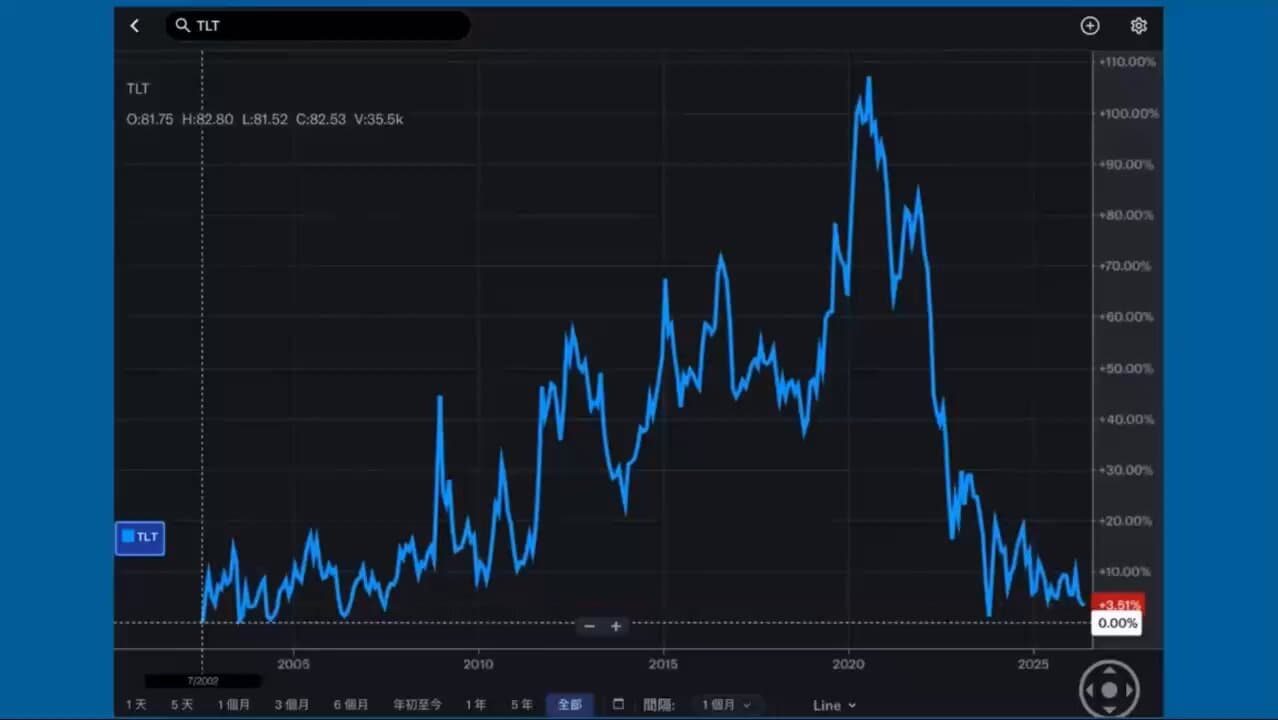
Touch Long-Term Bonds and Your Wealth Gets Blown to Pieces!
TLT has returned only about 4% a year over nearly twenty years, and anyone who bought the 2020 peak has watched it slide from 164 to 85. Avoid long-term, corporate, junk and structured bonds; the only ones to hold are short-term funds such as BOXX, SGOV, BIL and Taiwan's 00865B.
Shocking: A 16-Year Life Insurance Policy Returned Only 0.64%
After realizing a 16-year life insurance policy had earned only 0.64%, a reader surrendered the policy, moved into 00662, and asked James about allocation.
Newsletter
Join the community
Subscribe to our newsletter for the latest news and updates