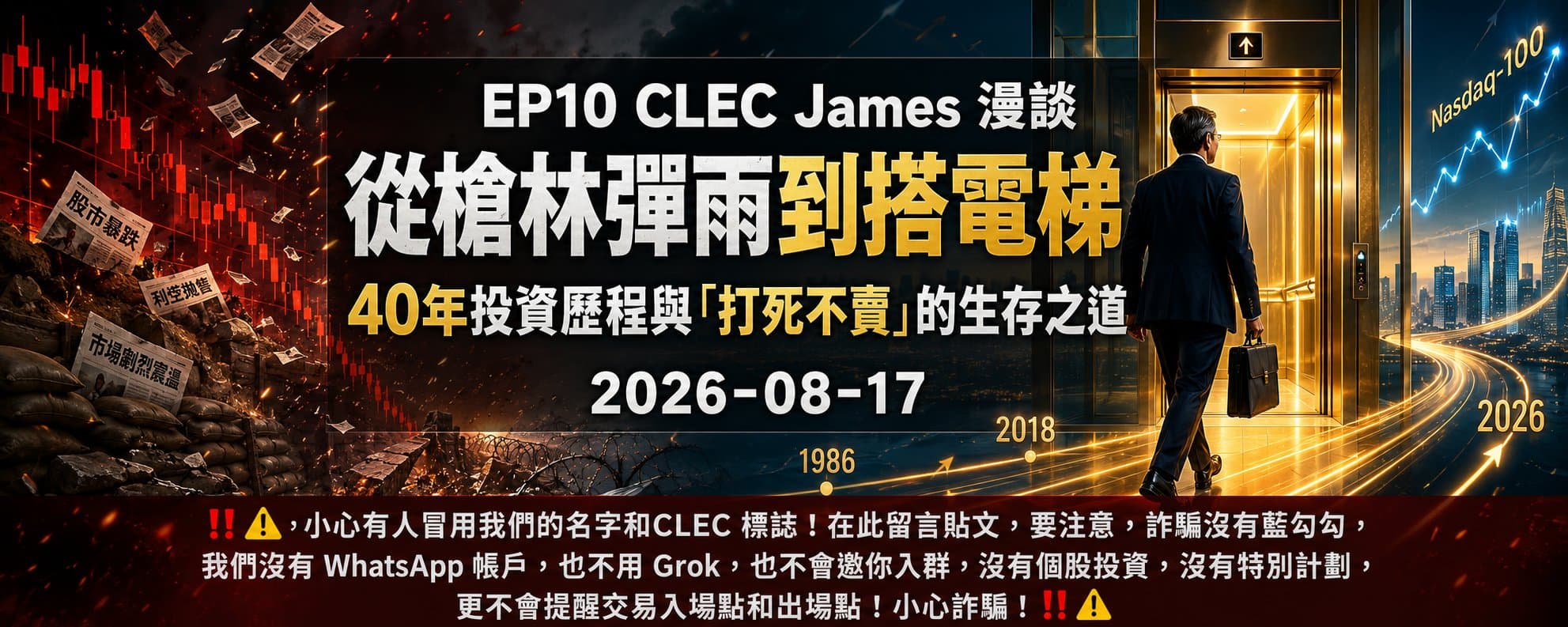
From a Hail of Bullets to Taking the Elevator: Forty Years of Investing and the Survival Rule of Never Selling
Episode ten of CLEC James Talks: three sentences from a Beijing barbecue restaurant owner turn out to match CLEC's long-term philosophy exactly. James looks back on twenty years of full margin and day trading as permanent warfare, until stock-backed borrowing in 2018 finally put him on the elevator.
Transcript (condensed, with filler words trimmed)
Hello everyone, this is CLEC James Talks, and I am James.
Today should be episode nine of James Talks. Today's topic comes mainly from a comment on X (Twitter). He said that while eating barbecue in Beijing, the owner of the barbecue restaurant turned out to be a veteran investor who had been trading A-shares for over twenty years. In their conversation, although the owner is a short-term trader who moves in and out, he said several things exactly in line with CLEC's long-term investing philosophy:
First, in the stock market you have to "stay alive"; the most important thing in investing is staying alive. Those are his own words.
Second, if you want to invest well you have to shut out all the noise. Do not read the analysts or the news; the same as us, ignoring the existence of it all.
Third, you earn as much money as the future wealth you can see. My reading of that is "earn the money within your understanding": the future wealth you can see is the wealth within your understanding.
For someone who has traded stocks for twenty years to say this, for this barbecue restaurant owner to articulate such an investing philosophy, those twenty-odd years of trading were not wasted. As for our own life experience, in my own investing over the past forty-odd years, the first twenty years were also short-term trading. That I am still alive today rests on the first point: the most important thing in investing is staying alive.
So the principles of successful investing are in fact consistent. Whether you are short-term trading, holding long, doing momentum investing, or using strategies with all sorts of grand names, these are the basic ways to survive: stay alive, ignore outside information (have your own independent capacity and your own view), and earn the money within your understanding.
In my first twenty years of investing I did every strategy there is: stocks, funds, stock picking, day trading, options, margin, short selling. Almost from the moment I started investing I was fully margined (100% margin). But I still survived, and the reason is that I cut losses extremely fast. For example, with 1 million dollars I would buy 2 million of stock; in America 100% margin is allowed.
So many people think, "James, you only know index investing." No: I have been through every strategy before and survived them. And the key I relied on was that "the most important thing in investing is staying alive."
In my past forty years of investing, in the first twenty years, if you are not investing long-term, then cutting losses is the only way to survive and the key within that kind of muddled strategy. Why do most people say stop-losses and cutting losses are so important? Because their strategies are themselves muddled strategies. My first twenty years were a muddled strategy.
Now we never cut losses at all; we "never sell, come what may." Investing long-term in a Nasdaq-100 index fund, you never need to cut losses. The way to survive in long-term investing is different from before: the muddled strategy relied on stop-losses, whereas the way we survive now in long-term investing is holding cash, with a cash flow that never breaks and never runs out.
Over the past forty years of investing, the first twenty really were like war. We were on high alert every moment, as if crouching in a trench with enemy bombs and a hail of bullets at any time, bullets coming from all directions. That was what our first twenty years of permanent wartime looked like; seen from now, it really was insane.
So I think most people who trade stocks are ignorant; at least I was ignorant then. Although I understood financial statements, understood industries, and understood technical analysis, for an investor these techniques are useless. At least they were useless for me; my experience tells me they are useless.
So why did I still make money? That I could make money in those first twenty muddled years is first of all luck; and second, from 1986 when I began investing in stocks (buying Acer shares back then) all the way to 2000, the environment was a bull market. In a bull market even ignorance can make money; it is just that I could have made much more and made much less because of the short-term trading.
A lot of short-term trading will cost you your life: living every day in tension, fear, and suspicion, that is the fate of the short-term trader. That I survived those first twenty years was entirely because the market was in a bull run; there is no other reason.
In short-term trading, if you make money today you might be happy for one minute; and at night in bed what you are thinking about is how the market will open tomorrow. When will the frightening information jump out? What new monsters will the world produce? When frightening news comes at you from every direction, waiting for tomorrow's open is always terrifying. You made money today, and tomorrow you still face a brand-new battlefield. Facing an unknown future is boundless fear, and that was my inner journey through those first twenty years. I understand very well the psychological state short-term traders face; some will say, "No, I am not that afraid," but they know best themselves when the fear wells up.
The time in which I truly switched to holding for the long term is actually less than twenty years. That change was fortunate; I moved naturally into long-term investing. I found that the Starbucks I once bought would have earned far more if I had not sold; the Apple I bought back then would have made me far richer if I had not sold; and the Amazon I bought at the bottom in 2008, you can imagine how much it would have earned if I had not sold. There were far too many "if only I had not sold," so in the end I changed to "sell as little as possible."
But individual stocks are always tormenting. The Magnificent Seven you see now, or many high-flying stocks, could in the past fall 50% for no reason at all. Holding individual stocks really is too hard, and even harder for people who understand technical analysis. Because we constantly see frightening moving averages lining up downward, or a break below the stop-loss point or below support; these ghost stories are there every single day. Look at weekly, daily, hourly, and minute charts and you will see ghosts in all of them. Even knowing they may all be false, you still break out in a cold sweat. Being able to hold still is already extraordinary; selling now and then is more the norm, and it really is very hard.
The more you understand the market, especially the more technical analysis you understand, the harder it is to hold long term. At that time, because I had already retired with no employment income, I needed to sell stock to live on; and although I knew I should hold long term, I always wanted to sell at a good price, or hoped the market would not keep falling when it fell, so I still traded.
Then one day it suddenly occurred to me: "Could I borrow?" We know Buffett can borrow, but we used to assume, presumptuously, that Buffett could borrow because he is Buffett and everyone knows him; if we went to the bank for a stock-backed loan, who would pay any attention to us?
That was our ignorance: we took our own subjective perception for fact. In truth, the things we are most certain of are often the most outrageously wrong.
When I had the idea of borrowing, I wrote an email to Lisa. I was delighted that Lisa called me that same day and told me, "You can borrow using stock as collateral!" This astonished me, and I immediately said, "Then I want to do it." Lisa then had a bank specialist call me and walk me through completing the application on the spot. In less than two weeks I had the stock-backed loan set up.
After that I began to "borrow and never sell, come what may." Looking back over forty years of investing, the first twenty were entirely ignorant. I thought I understood a great deal, but "understanding a great deal" and "being able to invest" are two completely different things. Many people think they understand financial statements, cycles, the economy, industries, technical analysis, and asset allocation, and pay dearly for the misunderstanding. Between 1986 and 2006 I thought I understood investing; in fact it was because the market was in a bull run, and I mistook the market's bull run for my own intelligence, which was a great misunderstanding.
In the ten years from 2005 when I was teaching investing, I did more long-term swing investing and was more careful in stock selection and in entries and exits. But because the environment was still a bull market, I seemed very impressive, leading everyone in picking stocks, buying, and selling. When I called a buy people bought, when I called a sell people sold, and we did make money in the market. I thought I understood, that I was an impressive teacher; in fact it was all the market's bull run, and I mistook the bull run for my own intelligence.
Only in 2018, when I started doing stock-backed borrowing, did I truly change to "hold index funds for the long term and never sell." That was when I finally boarded the elevator out of the battlefield of the stock market and was set free.
So what I teach everyone now is the "take the elevator" approach. I really did crawl out of the hail of bullets in the stock market; with any single slip in the past I could have been shot down at any moment, and there would be no CLEC today. Although when talking about my past I have said that I escaped the highs in 2000 and 2008 and caught the lows, making it sound as if I were a stock god, in fact behind those two correct calls I got it wrong no fewer than thirty-odd times. I am just "a broken clock that happened to point at the right time twice."
Everyone misunderstands, taking an investor who was right only twice for a stock god, when he may have been wrong hundreds of times. Just as Michael Burry got it right once in the subprime crisis and has not been right since.
So do not put too much faith in stock gods. My more than forty years of investing experience tells you this: unless you are superhuman, apart from long-term index fund investing, the survival rate of other strategies is not high. How hard is it to find a planet with life on it in the vast universe? Your chance of surviving on short-term trading in the stock market is exactly as hard as finding a planet with life in the vast universe.
So let us just invest in Earth with peace of mind.
More Posts
Australia's Financial Freedom Playbook: NDQ Plus IBKR Stock Pledging for Cash Without Selling
A post shares Australia-focused notes on NDQ, SMSF accounts, IBKR investor status, SBLOC-style borrowing, margin risk, tax treatment, and source links.

![Chapter 38 [Index Investing Is Simple, But Not Easy!]](/_next/image?url=%2Fimages%2Fblog%2Fjames-history-and-today%2Fen%2Fjames-history-and-today-0044-cover.png&w=3840&q=75 "Chapter 38 [Index Investing Is Simple, But Not Easy!]")
Chapter 38 [Index Investing Is Simple, But Not Easy!]
The simple thing: buy with money, hold for a long time, kill without selling (never leave the market). It's not easy: It's hard to go through 20, 40 years without moving like a mountain. Long-term index investing is easy, but not the easiest. Operator, looking at the wind is rain, buying and selling is easy. But it is not sustainable and stable long-term profits, or it is not a way for ordinary people to invest without doing anything. Operation is neither easy nor straightforward. Investors, not
![Chapter 10 [My Study After Retirement "Zi Wei Dou Shu" "Hypnotherapy"]](/_next/image?url=%2Fimages%2Fblog%2Fjames-history-and-today%2Fen%2Fjames-history-and-today-0010-cover.png&w=3840&q=75 "Chapter 10 [My Study After Retirement \"Zi Wei Dou Shu\" \"Hypnotherapy\"]")
Chapter 10 [My Study After Retirement "Zi Wei Dou Shu" "Hypnotherapy"]
Zi Wei Dou Shu Learning Zi Wei Dou Shu and hypnotherapy is the starting point for teaching investment and financial management in the United States. Speaking of which, when I retired and returned to the United States, of course I focused on taking care of my daughter first, but I was still thinking about what I should do next. I knew what I should learn, and maybe I should go back to school, but I just wouldn’t go back to work. I once thought about seeing if there is an archeology department or a history department at Stanford University. At that time, I felt that human civilization and wisdom should be in archeology or
Newsletter
Join the community
Subscribe to our newsletter for the latest news and updates