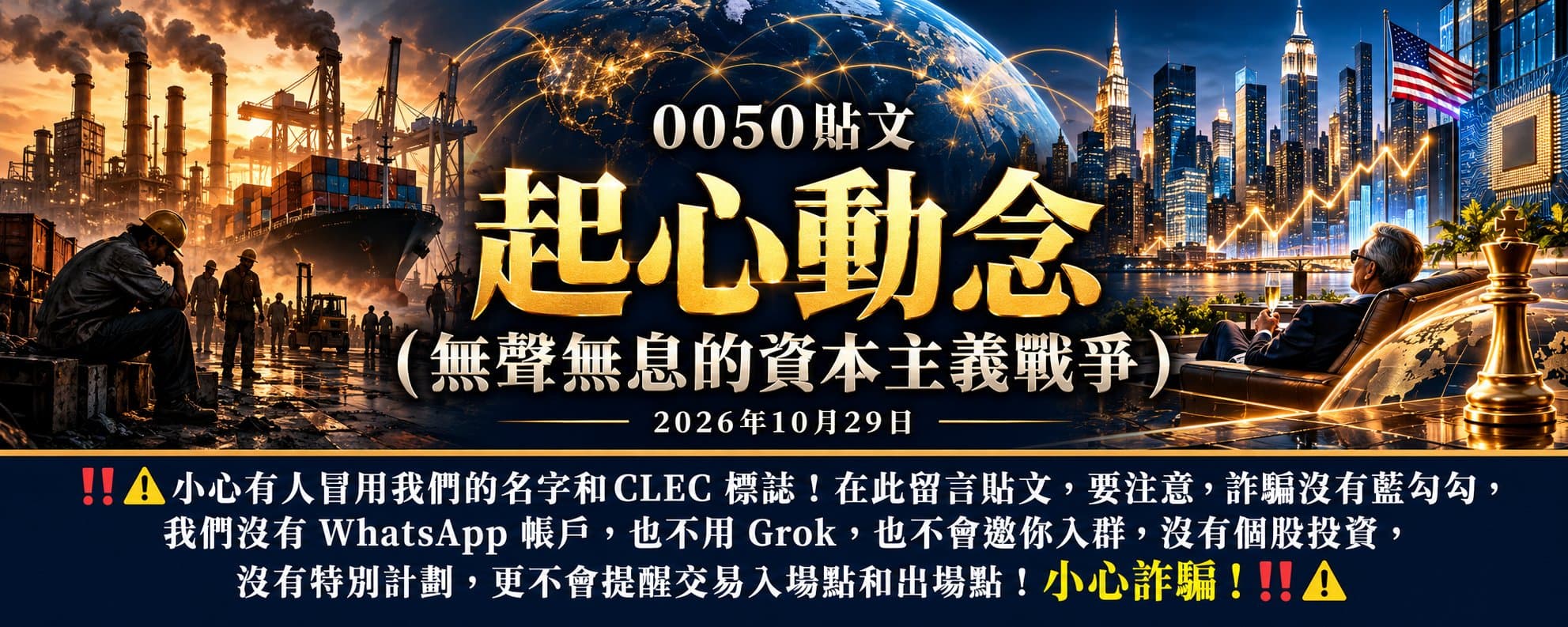
The Original Motivation (Capitalism’s Silent War)
James revisits his motivation for teaching investing and an article written between 2005 and 2008 about economic cycles, emerging countries, and capital.
Someone left a comment today asking why I have been teaching investing for thirty years. It reminded me again of my article about “awakening to capitalism,” so I am sharing it with everyone once more!
People ask why I work so hard to teach everyone how to build wealth through investing. This actually comes from what I felt after retiring in 2004. In 2005, I was enjoying a happy retirement, but I saw many friends and family members still struggling to make a living. I noticed that although Asians worked hard, they were not wealthy compared with people in Europe and America. (Some Asians owned several homes but had limited cash flow and still struggled to get by; that remained some distance from what Europeans and Americans meant by being wealthy.) People in Europe and America lived so comfortably without having to work a 9-9-6 schedule—nine in the morning to nine at night, six days a week. Where had things gone wrong?
There is a silent “war of capitalism” here. Asians and people in emerging countries are being enslaved without realizing it.
Awakening to the Nature of Capitalism Through the New Economy (Note the Historical Context: From 2005 to the Subprime Bubble)
(1) The Dynamics of the World Economy
In the past, the digitalization of technology and the liberalization of global finance accelerated flows of money around the world, leading to the rapid concentration of funds in global capital markets. Reforms and opening up in socialist countries also increased the global labor supply, improved efficiency, and allowed goods to move more freely—putting people's talents to use and letting goods circulate smoothly. These were the main drivers of the great leap forward in the global economy.
Future economic momentum will be led by internet-based business models that rapidly spread innovations and products around the world, improve logistics, and raise the overall efficiency of economic and business activity, creating future growth.
Amid these rapidly changing business models, Europe and America have used advanced financial operations and capital management, together with strong innovative capacity and a willingness to take risks, to create the newest internet business and profit models. They have also used their vast capital to invade global funds and resources—buying up the best companies in emerging countries—and have become the biggest beneficiaries and controllers of the capitalist market.
Europe has also profited from the economic value created by bringing Eastern European resources into the global economic chain. After East and West Germany reunified, West Germany was the greatest beneficiary. Of course, China, India, and Southeast Asia are also the fuel—the suppliers of labor—for the world economy's present and future momentum. In this process, damage to the natural environment has received the least attention, or rather has been completely ignored. Under an economic model pursuing rapid GDP growth through production, manufacturing, and exports, emerging countries and their workers have been exploited by Europe and America. They are not the greatest beneficiaries; they are the ones most deeply harmed.
An economic cycle takes roughly several decades. The great cycle of the 1980s and 1990s was driven by innovations in personal computers and the internet, and it burst in 2000. It was followed by a cycle driven by American financial innovation, which peaked with U.S. subprime mortgages in 2007, creating an asset bubble that almost brought down global finance and the economy. America's property and asset bubbles burst, its stock market bottomed in 2009, and the economy only began rising slowly in 2013. Europe and America printed large amounts of money and quickly emerged from recession, but emerging countries were still suffering from the bubble's devastation in 2013. Capitalist bubbles create opportunities to redistribute wealth. The United States uses the dollar's position to extract wealth from emerging countries with every bubble and financial tsunami—an assault by the formidable firepower of the American financial industry.
Seizing one redistribution of wealth can make you well-off; seizing two can make you wealthy; seizing three can make you immensely rich. The key is whether you emerge a winner when wealth is redistributed, rather than having your wealth redistributed away.
No one really knows how the next global economic cycle will develop or which technology or innovation will drive it. In any case, we were fortunate to witness the beginning of a new cycle in 2008. This was the start of a redistribution of wealth. We should seize the best opportunity to gain more wealth from the market; this is a right capitalism offers us. What we need to prepare for is making the right investments at the right stage of the economic cycle.
(2) The Fate of Emerging Countries
As capitalist economic growth spreads around the globe and human development and civilization accelerate, developed countries are the greatest beneficiaries of the process, followed by developing countries, which receive some meager wages. Developed countries take most of the profits; developing countries receive only payment for their labor, together with environmental pollution and destruction.
Developed countries are the monarchs and aristocrats of global capitalism, while developing countries are its commoners and workers. Aristocrats and workers have always competed on unequal terms. Developed countries grow wealthy at an accelerating pace, while emerging countries only slowly reach subsistence. This is the result capitalism produces, and it is also their fate. The same applies to individuals. Those who understand how capitalism works, like developed countries, obtain the greatest economic gains and profits. Countries and individuals who do not understand capital markets, like emerging countries, receive only meager wages and pay in a capitalist environment. This has nothing to do with where you live; it has to do with your knowledge of how capital works and your mindset. We must improve our knowledge of investing and capital management. Only by changing our mindset can we change our fate.
This is true of countries, and individuals cannot escape capitalism's control either. In this era of a rising new economy, people who earn wages through their labor are like the people of developing countries: they can only ever get by, never become wealthy. Emerging countries should make more financial tools available to their citizens, allowing them to obtain funds for financial investment and invest more conveniently in U.S. index funds. In this way, they can share in Americans' output and growth in value and improve financial efficiency.
In addition, emerging countries can invest in the balanced development of their domestic industries. Individuals can enrich their inner lives and their financial knowledge, arranging the best investments for national foreign exchange reserves and personal income. Citizens can make the best long-term investment arrangements for their earnings by investing in U.S. stock index funds. Sovereign wealth funds can invest in U.S. indexes to acquire ownership of American companies, making those companies and the American people work for our country as our workers—turning their own approach back on them, with the profits owned and shared by everyone. Emerging countries can then have developed countries—the capital owners—work for them and share in most of the wealth the world creates in the future, instead of becoming exploited workers. It is like landlords in the past enjoying all the harvest while tenant farmers could only ever scrape by through hard labor. Whether for an individual or a country, the sooner one awakens and invests correctly, the higher the quality of life one can enjoy in the future, changing from tenant farmer to landlord.
Some people may, of course, think this places too much emphasis on money and material enjoyment. But in this silent war of capitalism, if all we know is how to build factories, work hard at production, manufacture goods, and export them to earn money through labor—or simply work hard at our jobs for meager wages—we will forever be like tenant farmers scraping together a living and will be unable to change our fate as workers. National leaders and citizens should therefore think deeply about this issue: how to move from being workers to being capital owners, and what policies can be used to resist capitalism. In this way, we can truly grow our wealth, improve our quality of life, and avoid being enslaved by the capitalist system. I hope everyone will start now to actively learn about investing, bravely face capitalism's challenges, and achieve their wealth goals.
Let us work together to change our fate and make the future better.
Written by James between 2005 and 2008.
Please click the link below; there may be a newer version!
【The Original Motivation (Capitalism’s Silent War)】
More Posts

青春期不是叛逆,而是走向獨立:父母學會放手,也勇敢面對自己
CLEC James 漫談第24集:青春期不是叛逆,而是走向獨立:父母學會放手,也勇敢面對自己

Chapter 36 [Ethics and the Thinker Revolution]
We generally operate in society with "ethics" and "morality", of which "Lun" talks about relationships, so you have to play your "reason" and "morality" depends on relationships. Before you start helping, you should think, is it just you in this relationship with the person you want to help? He has children, so it's not our turn! This is "ethics". Our society generally operates as "ethical" and "moral" thinkers and revolutionaries, which is different. He is facing a group, and the group is an individual.
Chapter 69 [Three Questions about Investment]
Question 1: I see that SPY/QQQ, etc. are at high levels recently (2019). Should I buy an ETF with high dividends and low volatility such as VYM when entering the market? Because the market is already at a high level now, the next correction should be very strong, right? Answer 1: We cannot predict the market! Some people claim to be able to predict the market, but we admit that we are not. You can invest in SPY, QQQ, or VYM, but what you need to consider is the long-term return.
Newsletter
Join the community
Subscribe to our newsletter for the latest news and updates