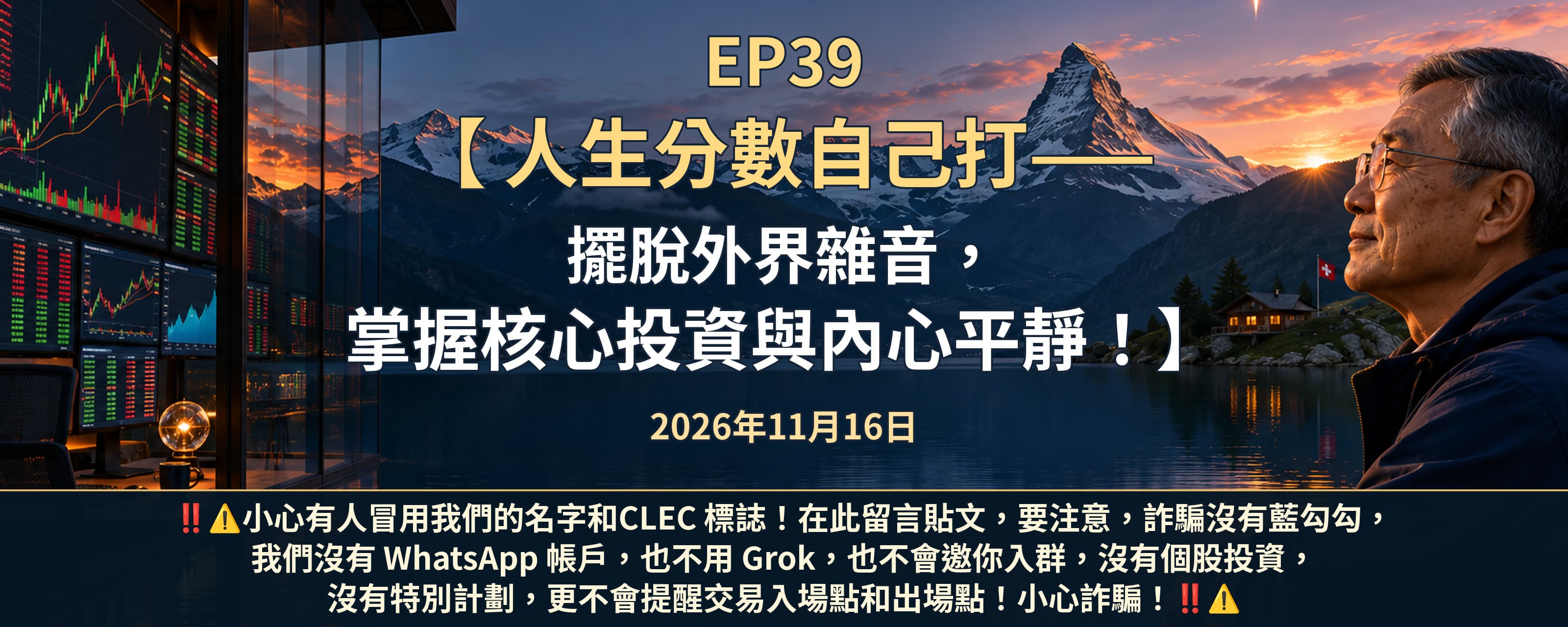
Score Your Own Life—Tune Out External Noise, Master Core Investing and Inner Peace!
CLEC James Chat EP39: Living by your own scorecard, ignoring forecasts, building cash flow under 33x expenses, weighing home sales against peace of mind, and buying immediately at market price.
Hello everyone, welcome to CLEC James Chat—I'm James.
Today let's talk about a few things. The first is that you are the one who scores your own life, not the outside world. What prompted me to bring this up was a show I listened to last night about a fund manager who had lunch with Warren Buffett and learned a great deal from him.
One of those lessons was that because he was a fund manager, he constantly had to measure his performance against the outside world, so outside commentary and peer comparisons often threw off his decision-making. Later, after having lunch with Buffett, he moved his fund to a scenic spot in Switzerland far away from Wall Street, stopped taking outside inquiries, stopped watching the ticker, and focused purely on researching his investments. That made his life far more relaxed—and his returns actually improved.
So the point here is that our lives shouldn't be judged by external standards, but by whether we can live peacefully and happily. If you're already able to retire, then retire—don't worry about outsiders saying, "Oh, retiring so young, isn't that this or that?" None of that matters. Your own happy, fulfilling days belong to you. Other people's opinions don't matter—that's not our problem, it's theirs. Life is meant to be lived for yourself, and health and happiness matter most.
Next, SpaceX succeeded in recovering its rocket—that's technological progress. We know human technology will keep advancing. We aren't recommending any single stock; we're simply sharing that as human technology continues to move forward, our investments will continue to grow. Even though there is volatility along the way, ignore that volatility—just believe in humanity, believe in technology, and believe in the United States. Even if you don't believe in the United States, believing in humanity and technology can never go wrong. As the whole world progresses, our investments will appreciate.
Next, over the past couple of days I received several emails from people whose assets are still below 33 times their annual expenses. Many people are worried about losing their jobs because there has been a lot of workplace upheaval lately and quite a few layoffs—especially for those working in the internet industry.
So what can they do if their assets haven't reached 33x yet? Even though we generally don't advise non-U.S. residents to open U.S. brokerage accounts, one option is to invest in QQQI through HSBC Hong Kong; however, since HSBC Hong Kong involves CRS reporting considerations, another option is Firstrade. Firstrade provides an ATM/debit card, which lets you withdraw cash back home, so Firstrade can work too—and ideally as a joint account so things can still be handled if anything unexpected happens. By investing in QQQI first to secure cash flow—say someone has 2 million and needs 120,000 a year—they might put 1.2 million into QQQI to generate 120,000 in annual cash flow, and allocate the remainder in a 70/30 portfolio. That's one way people with insufficient current assets who need cash flow can handle the gap.
As for all the forecasts out there, don't pay any attention to them—not because they're right or wrong, since even if they're right it doesn't help, and if they're wrong it doesn't help either. We aren't going to change our investment direction because of anyone's predictions, so simply don't listen and don't look—then they don't exist. Shut out all that outside noise, just like that fund manager who moved to Switzerland: by neither listening nor looking, none of it existed for him, and he lived a peaceful, happy life. Our investing is the same: we ignore all of it, take care of our own asset allocation, and once that allocation is set, there's no need to keep meddling with it. Ensure your long-term cash flow, live your happy life, and let the market swing however it wants—it has nothing to do with us. That is our strategy: no flashy forecasts, no fancy analysis—no analysis needed at all.
Some people ask: "We talk about 33x or 50x, so what if the market drops and my assets are no longer at 33x or 50x?" In fact, our 33x or 50x benchmark is measured at the market's peak. If the market falls and you dip below 33x or 50x, that's totally fine, because the further the market falls, the safer it actually becomes. It's at market peaks that risk is higher, which is why you want 50x or 33x annual expenses there. Once the market has dropped—say down 30%—it's safer than before the decline started. So if your portfolio pulls back below 33x, it doesn't matter; just let our asset allocation run on autopilot and don't worry.
When people are deciding whether to sell their house, I usually recommend selling. Lately, though, some people feel the house is where their children were born and grew up, with deep emotional attachment, and they can't bear to part with it. If you can't bear to sell it, then don't sell it. If your finances are still fine without selling, keep it. One friend sold his house, regretted it nonstop afterward, and ended up having to visit a mental health clinic—there's really no need for that. You have to weigh your own psychological state rather than blindly forcing yourself to sell a home just to invest. Physical, mental, and emotional well-being should always come first. If you have strong feelings for your home and selling it would leave you deeply scarred even though you'd have more money to invest, it isn't worth it—never harm your well-being for the sake of investing.
Don't wait to invest. Even though the market is volatile and pulling back right now, if you ask me, "Teacher, I have 500,000—should I buy in tranches or what?" I'm still going to tell you to buy immediately at market price. Even though telling someone to buy immediately at market price isn't the most crowd-pleasing answer if the market drops further afterward, based on my understanding and my conscience, I will still tell you to buy immediately at market price. Who knows whether tomorrow will surge or plunge? Nobody knows. Telling you to buy in tranches might sound like a safe, middle-of-the-road answer, yet for myself I would buy immediately at market price—so naturally that's the same answer I give everyone else, right?
So if it's money you can invest for 15 years, 30 years, 100 years—across generations—just buy immediately at market price; there's nothing to stagger into tranches. Conversely, money you cannot commit for the long term shouldn't be put into the market at all—it's that simple. Why do we keep cash reserves and build cash flow? Because that's the money that must not go into the market. Anything that can go into the market should be invested immediately at market price. You just need to distinguish between money you can invest and money you cannot. When you ask me how to invest 500,000, that means it's investable money—so of course you buy immediately at market price, shut off your screen, and stop looking.
Alright, that's all I want to share for today. Market volatility has nothing to do with us—nothing at all. Human technology will keep advancing; as long as you invest for the long term, buy whenever you have money, and never sell no matter what, you will become wealthy. Everything else is irrelevant to us. Don't listen to outside chatter, don't look at it, and it simply doesn't exist. Go enjoy your own happy life.
Okay, let's leave it there for now and chat again when we have time. Okay, bye-bye!
Listen on Apple Podcast: https://podcasts.apple.com/us/podcast/clec-james-%E6%BC%AB%E8%AB%87/id6798136771?l=zh-Hant-TW&i=1000802323692
Listen on Spotify
More Posts
The Seven Stages of Investing
The Seven Stages of Investing. Written on August 23, 2018. Investing has seven stages: hearing about it, knowing it, understanding it, believing it, executing it, enduring it, and finally reaching conviction.


讓知識是平的|喚醒資本主義自覺|也無風雨也無晴
CLEC James 漫談第15集:讓知識是平的|喚醒資本主義自覺|也無風雨也無晴
Chapter 16 [Interview with Teacher Meixiang: Conversations with Money] Part 6-2 The Conditions for a Person to Have Money
'Interview with Teacher Meixiang: Conversations with Money' Part 6-2 (02/21/2023) 2. The conditions for a person to have money (what I commonly refer to as a wealthy person) - Wealth is not just having money; it also requires joy and happiness. A wealthy person will definitely have money. For a self-made person to become wealthy, there are three steps or three conditions: 1. Work to earn money. We are not second-generation rich; everyone has to work at the beginning, but if you want to become rich, you must save money. Keeping accounts
Newsletter
Join the community
Subscribe to our newsletter for the latest news and updates