Video Overview
This course segment begins with historical SPY charts to show how the speaker distinguishes short-term volatility from long-term returns, while acknowledging that daily and weekly market moves cannot be predicted reliably. It then compares dividends, stock indexes, real estate, and other assets to explain why the speaker favors holding a broad stock index for the long term. The second half turns to retirement planning, using different starting ages, monthly contributions, and annual spending scenarios to illustrate the role of time and compounding within the video's models. Every return, dollar amount, and portfolio-longevity result is a chart-based example or an assumption presented by the speaker, not a guarantee of market performance or personalized investment advice from this site.
Key Takeaways
- The speaker cites a 1950–2015 SPY chart and uses a 7.5% annualized return plus roughly 2% in dividends as the video's long-term example, while acknowledging that short-term moves cannot be known in advance.
- Dividend and historical asset charts, followed by a separate real-estate example, are used to explain why the speaker favors stock indexes; the growth rates and comparisons are claims made in the video.
- A retirement accumulation model compares different starting dates and monthly contributions to emphasize the speaker's case for saving early, spending less, and keeping money invested.
- A retirement withdrawal model assumes a $1 million starting balance and several annual spending levels to show how spending slightly above or below the model's return can produce sharply different outcomes.
Chapters
About 00:00:08 · Long-Term SPY Charts and Short-Term Volatility
The speaker estimates long-term returns from historical SPY data, says daily or weekly moves are difficult to predict, and argues for focusing on a longer time horizon.
About 00:02:15 · Dividends, Business Growth, and Asset Comparisons
The video moves from dividends and business efficiency to historical charts for stocks, bonds, gold, and cash, then uses a real-estate example to explain the speaker's preference.
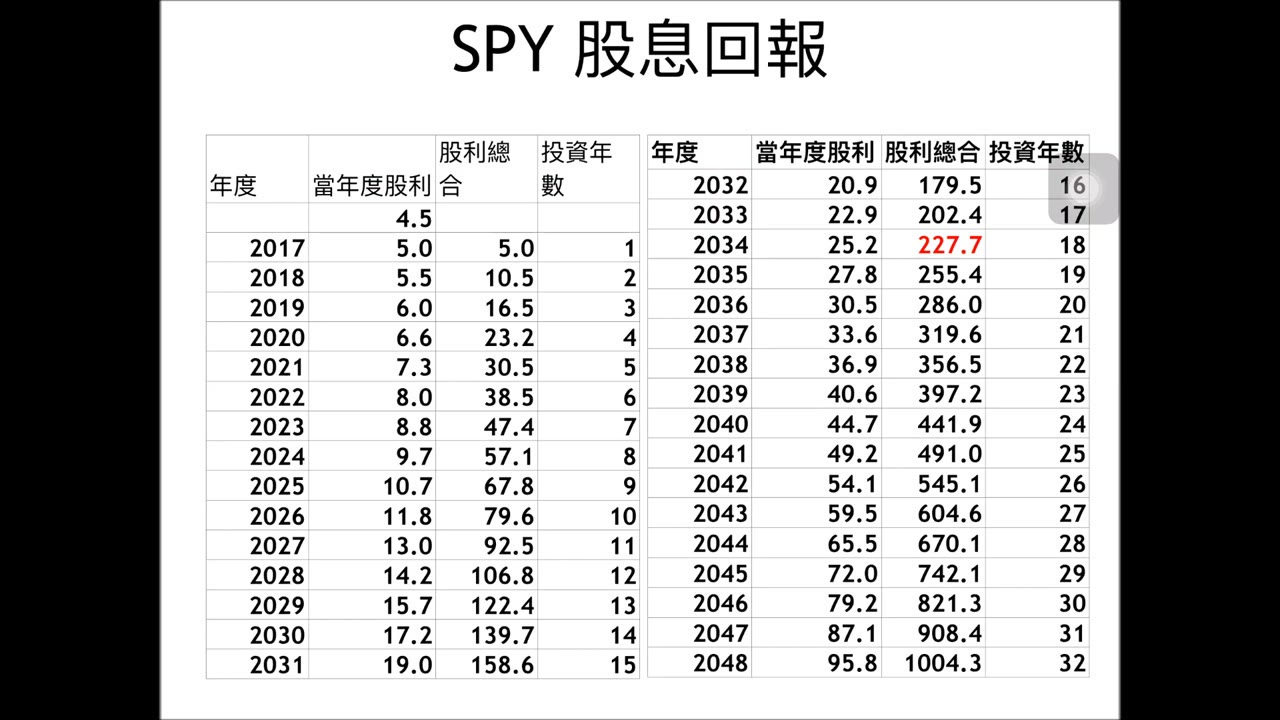
About 00:04:22 · Dividend Payback and a Rental Comparison
Assuming past returns continue, the speaker models cumulative dividends and recovery of the initial investment, then compares the result with rent and property-management costs.
About 00:06:37 · Retirement Targets and Starting Early
Using a $1 million retirement target and a Taiwan-based scenario, the video estimates monthly contributions over different time horizons to illustrate the model's compounding effect.
About 00:09:34 · Annual Spending and Portfolio Longevity
The speaker varies annual retirement spending to show how the starting balance might hold steady, grow, or be depleted under different assumptions, framing spending control as central to financial freedom.
Related Topics
long-term SPY performance, short-term market volatility, dividends and return assumptions, stock indexes and real estate, retirement accumulation, starting to save early, time and compounding, retirement withdrawal models
This page was prepared with AI from selected portions of the video's audio to help readers understand the main topics. It may omit secondary material or contain transcription errors; the original video remains authoritative.