
Master Asset Allocation While Young: Credit, Leverage, and Long-Term Investing
A student in her twenties outlines family assets, property sales, loans and retirement plans, then asks about Nasdaq-100 fund premiums and leverage; James responds with an allocation and cash-reserve view.
Teacher James, hello:
I am a student from mainland China. First, I truly want to thank you for your dedication and generosity in bringing us so much valuable spiritual wealth. To me, this knowledge is worth tens of billions and is a priceless treasure!
I learned about you through Bilibili in mainland China. Over the past two months, I have watched from episode 00451 in 2024 all the way through the current episode 00576, and I will slowly catch up on the earlier videos as well.
Because I am still working and have two lovely dogs at home who need companionship, I do not have much quiet time alone. Whenever I watch your videos, I deliberately choose a quieter time and place so I can watch carefully, take notes, and think closely about the content.
Because of internet restrictions in mainland China, I cannot join you live, so I decided to communicate with you by letter.
This is my first letter to you and I feel somewhat nervous. Please excuse any problems with the format or wording. The content may also be a little disorganized because I am truly very excited, and I ask for your understanding.
I have already found answers to roughly 80% of my questions through the handbook and videos you organized, but several questions still puzzle me and I hope to receive your guidance.
My Basic Situation
I am in my twenties, an only daughter, and currently live with my parents.
My parents both have pensions, relatively comprehensive medical coverage, stable housing, and a vacant property that they rent out. For the next ten years or more, I do not currently need to worry about their main living and medical expenses.
I am currently unmarried and have no children, but I am engaged. I previously started a business and now have a stable job with monthly after-tax income of about RMB 7,000; my former full-time business has become a side business and still brings in about RMB 2,000 per month.
My fiancé earns about RMB 4,000 per month after tax. We have been together for many years and our relationship is stable. He supports all my decisions, trusts me 100% on investing and financial management, and is even willing to contribute his entire salary to our family plan.
His parents also currently have stable jobs, but their pensions and medical coverage are less comprehensive than my parents’. Even so, there should not be much support pressure over the next ten years or more.
A simple summary:
The two of us currently have RMB 300,000 in savings that we can use freely. After daily living expenses, we have about RMB 5,000 each month available for recurring investments.
What I Am Currently Doing
My parents own an old apartment in a primary-school district that rents for about RMB 2,000 per month. At my urging, they have decided to sell it and are willing to let me plan and use the proceeds together.
I promised my parents:
After ten years, I will provide them RMB 10,000 per month as additional retirement income to improve their quality of life; after fifteen years, I will raise it to RMB 15,000 per month; and after seventeen years, to RMB 20,000 per month.
I also wrote a formal guarantee and IOU so they could feel at ease.
Of course, I know my parents would never actually use those documents to pressure me. They love me very much, and I love them. I wrote them because I want them to feel more comfortable entrusting the funds to me for planning.
The timing of the sale is not yet certain, but we will try to sell the property this year. As you have said, even if we need to accept a discount, we should sell it as soon as possible. We expect the sale to produce about RMB 650,000.
My fiancé’s parents also set aside a home down payment of about RMB 400,000 for us. It is currently in a time deposit that will mature in about three years, after which it can also be entrusted to me for unified planning.
In addition, my credit record is good, and I expect to qualify for a consumer loan of about RMB 300,000 from a bank at an annual interest rate of roughly 3.5%, repayable over as long as five years.
I also own a company and serve as its responsible person. If I apply for a business operating loan, I may be able to obtain a higher limit at a lower interest rate.
Future Family Plans
In the future, our small family and both sets of parents plan to remain in mainland China.
Because my fiancé and I are both only children, we want to plan early for both sets of parents in retirement. We worry that in ten or fifteen years we could face elderly parents above, children below, and insufficient funds on hand, so we hope to begin preparing now.
On one hand, we hope both sets of parents can enjoy a better retirement. On the other, we also hope to retire early, escape laboring life, and redeem our own freedom.
About My Ability to Execute
Teacher James, you do not need to worry at all about my ability to carry out a plan.
After listening to your course, I decisively canceled an annuity insurance policy. It originally required annual payments of RMB 50,000 for five consecutive years. I had already paid RMB 50,000, but could recover only RMB 24,000 when canceling it.
Even though I lost RMB 26,000, I did not feel distressed at all. I did not think of it as losing RMB 26,000, but as saving the RMB 200,000 I would otherwise have paid in the future, allowing that money to go somewhere more appropriate.
Even though the bank representative repeatedly tried to stop me, I still went ahead and completed the cancellation.
Following your “Han Xin counts the troops” approach, I also reorganized all my assets. I decisively sold gold that I had bought without understanding investing, despite a RMB 7,000 loss, and stopped and exited all the other miscellaneous funds as well.
I have now assembled a total of RMB 300,000 in investable cash, which is waiting in the account to be allocated.
So, Teacher, you can make bold recommendations based on my situation. I would have no problem even with a beta 1.2 allocation.
My psychological tolerance is relatively strong. In my twenties, I dared to borrow RMB 100,000 to start a business. I can psychologically accept either leveraged investing or personal credit loans.
I have also prepared myself mentally for the market to fall 80% tomorrow. If the market really drops sharply, my response will be to add aggressively, because I would see the decline as a reward for young investors.
I am still young, have stable cash flow, and am prepared to “buy and never sell even if it kills me.”
Two Core Questions
First question:
Based on the family situation, current assets, possible future property-sale proceeds, and the cash flow we can continue investing every month, what asset allocation does Teacher James think is most suitable for me now?
Second question:
One of the biggest differences between buying funds such as 513300 that track the Nasdaq-100 in mainland China and investing directly in the United States or Taiwan is that exchange-traded funds here often carry a relatively high premium.
The recent premium has been about 12%. In this situation, should I ignore the premium and buy decisively, or should I wait until the premium falls to a reasonable level before entering?
I have made a possible allocation that may still be immature:
Use 60% of the funds to buy 513300 in mainland China, and take the other 40% to open an account in Hong Kong and buy a two-times leveraged fund such as QLD.
At this stage, I do not plan to retain a cash position. Instead, I would treat my unused bank borrowing limit as reserve cash.
If the market falls 30%, 50%, or even 80%, I would immediately apply for a personal credit loan from the bank and use the borrowed funds to add to the position.
I do not know whether this plan is feasible. It is only my still-immature idea, and I hope to receive your guidance and corrections.
If Teacher James has read this far, I am truly grateful for your patience and for giving me your precious time amid your busy schedule.
I will not let down the time you have spent on me, and I will seriously carry out the recommendations and plan you give me.
Once again, I offer Teacher James my most sincere thanks!
This email is rather long and has taken up your valuable time. I respectfully await your reply.
James’s Reply
You are an outstanding young person! Your plan is feasible because you know what you are doing. I would not agree to this type of investment allocation for everyone!
However, I would still suggest placing 30% of the funds in Hong Kong to invest in a two-times leveraged fund listed there, while retaining another 10% in cash. That would be more appropriate.
When buying a Nasdaq-100 index fund in mainland China, you do not need to pay attention to the premium. If you can transfer all the funds to HSBC Hong Kong, you can of course also use HSBC Hong Kong directly to buy a Nasdaq-100 index fund listed in Hong Kong, which would avoid the premium on mainland Chinese funds.
It is truly remarkable that at such a young age you have earned the trust of both sets of parents. This is credit you have accumulated over many years, and the most valuable thing in life is credit. Getting your parents to agree to sell the property already shows that you are a highly trustworthy young person.
You should marry and have children earlier; the sooner you marry, the better. Have children earlier too—two is just right, and three is not too many!
You are both still quite young. The funds invested now, after long-term investment and growth, will make you very wealthy in the future.
Your future assets will certainly be more than you can ever spend!
If you like our posts, please Like, Follow, Comment, and Repost:
Written by: James
We are not professional investment advisers or professional tax practitioners. Investing involves risk; you must do your own research, make your own decisions, and take responsibility for them.
‼️⚠️Beware of people impersonating us and using the CLEC logo! Be careful with comments on this post. Scammers do not have a blue check. We do not have a WhatsApp account, do not use Grok, do not invite you into groups, do not offer individual-stock investments or special plans, and never alert you to trade entry or exit points. Beware of scams!‼️⚠️
Author

Categories
More Posts
Money Creates Confidence: When Assets Grow, a Homemaker Feels Financial Autonomy for the First Time
A homemaker shares how investing a home-equity loan brought confidence, autonomy, and happiness after 25 years at home with new strength.
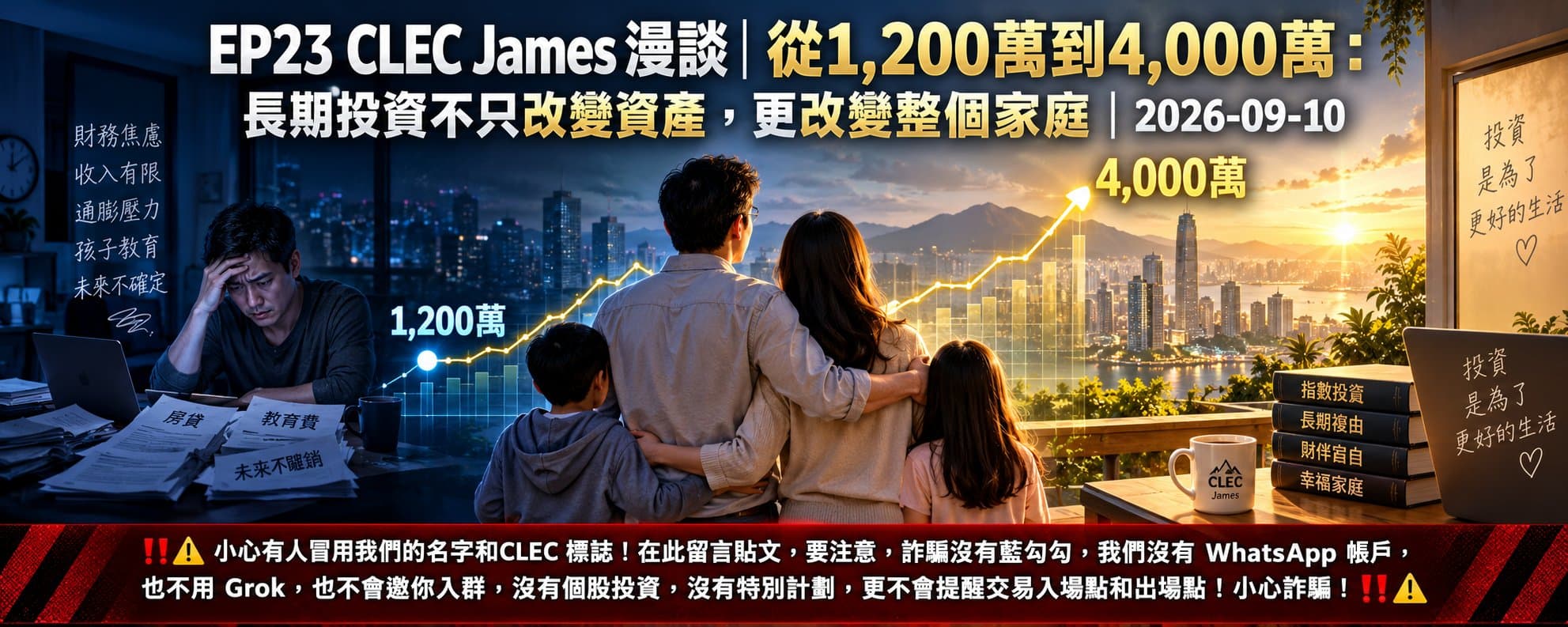
從1,200萬到4,000萬:長期投資不只改變資產,更改變整個家庭
CLEC James 漫談第23集:從1,200萬到4,000萬:長期投資不只改變資產,更改變整個家庭
![Chapter 81 [Letter from students asking questions]](/_next/image?url=%2Fimages%2Fblog%2Fjames-history-and-today%2Fen%2Fjames-history-and-today-0087-cover.png&w=3840&q=75 "Chapter 81 [Letter from students asking questions]")
Chapter 81 [Letter from students asking questions]
"Hi James, thank you for your reply. \"That is assuming that you happened to buy at the highest point in 2007. If you buy at the lowest point in 2009, the annualized return can reach 20%. The annualized return depends on your fate! Investors in 2007, the end of 2021 and the beginning of 2022 are a little worse. Those who start investing at the end of 2009 and now will have a better life. One fate, two luck, and three themselves." This sentence is really well written, do you think 2023
Newsletter
Join the community
Subscribe to our newsletter for the latest news and updates