CLEC Investment & WealthCLEC Investment & Wealth
  1. Home
  2. Video
  3. Topics
  4. Managing an 8 Million Traditional U.S. Retirement Account: Withdrawing About 11.5% and Converting 115,000 per Year from Each Million (Assuming 10% Annual Returns)
Managing an 8 Million Traditional U.S. Retirement Account: Withdrawing About 11.5% and Converting 115,000 per Year from Each Million (Assuming 10% Annual Returns)
Unable to play this video: Managing an 8 Million Traditional U.S. Retirement Account: Withdrawing About 11.5% and Converting 115,000 per Year from Each Million (Assuming 10% Annual Returns)

Video information

00002

Managing an 8 Million Traditional U.S. Retirement Account: Withdrawing About 11.5% and Converting 115,000 per Year from Each Million (Assuming 10% Annual Returns)

Using a U.S. retirement worksheet and individual cases, the video discusses traditional accounts, former-employer 401(k)s, rollover IRAs, return assumptions, RMDs, switching costs, and worksheet access.

Published
Dec 18, 2023
Total duration
2:02:00
Source
CLEC Investment & Wealth

Categories

  • Topics

Video Overview

The video centers on a U.S. retirement-planning worksheet. The speaker says differences in retirement age, account type, and account size make one rule difficult to apply, so the discussion uses individual cases. It covers former-employer 401(k)s, traditional and Roth accounts, rollover IRAs, and trade-offs in locating assets across accounts. The speaker cautions against treating a short holding period as equivalent to a long-term average-return assumption. Later questions address RMDs, growth in traditional accounts, possible tax costs when changing positions, and the speaker's view of QQQ versus small-cap exposure. The video also explains how to export the worksheet from Google Sheets to Excel. The closing links traditional account size to the ability to make future conversions within a manageable marginal tax rate.

Key Takeaways

  • The retirement worksheet aids calculation, but differences in retirement age, account structure, and personal circumstances still require case-by-case interpretation.
  • Former-employer 401(k)s, rollover IRAs, and traditional and Roth accounts are compared, focusing on trade-offs between account growth and asset location.
  • The video says a long-term average-return assumption should not be applied directly to a short holding period because the time horizon changes the result.
  • In the QQQ and small-cap discussion, the speaker considers long-term performance, outcomes across several holdings, and later switching costs without presenting a universal conclusion.
  • The closing connects traditional account size with future conversion capacity and a personally manageable marginal tax rate.

Chapters

About 00:00:00 · Retirement worksheet and case examples

The speaker introduces the third version of a retirement-planning worksheet and explains why differences among individual cases make one general rule difficult to apply.

About 00:23:23 · Former 401(k) and account allocation

The discussion compares a former-employer 401(k), a rollover IRA, and traditional and Roth accounts, including the video's examples of locating assets in different accounts.

About 00:41:41 · RMDs and the return time horizon

The video discusses RMD pressure after continued growth in a traditional IRA and says that a long-term average return cannot be applied directly to a shorter withdrawal period.

About 01:18:17 · Small caps and QQQ

Responding to a question about adding small caps, the speaker discusses long-term performance, variation among holdings, and the cost of switching positions later.

About 01:36:35 · Downloading and exporting the worksheet

This segment addresses the updated link and mobile access, explaining how to share or export the Google Sheet and then open it in Excel on a computer.

About 01:59:59 · Traditional account size and conversions

The closing acknowledges that the case and worksheet demonstration were not completed, then returns to controlling traditional account size and considering room for future conversions.

Related Topics

U.S. retirement-planning worksheet, traditional retirement accounts, former-employer 401(k), rollover IRA, Roth accounts, required minimum distributions, long-term return assumptions, retirement account conversions, QQQ and small-cap stocks, Google Sheets export

This page was prepared with AI from selected portions of the video's audio to help readers understand the main topics. It may omit secondary material or contain transcription errors; the original video remains authoritative.


All Videos

More Videos

Why Non-U.S. Investors Should Consider UCITS ETFs for the Nasdaq-100
00049Jan 1, 2026

Why Non-U.S. Investors Should Consider UCITS ETFs for the Nasdaq-100

Topics

Why Non-U.S. Investors Should Consider UCITS ETFs for the Nasdaq-100

The video discusses U.S. estate-tax considerations for non-U.S. investors holding U.S.-domiciled ETFs, introduces the UCITS structure, compares EQQQ and CNDX, and walks through an international-broker example.

Jan 1, 20269:36
Retirement Withdrawals and QQQ Beyond Tech Stocks: Selling a Home and Going All In on QQQ vs. the Belief That Property Creates Wealth (English Audio)
00048Dec 30, 2025

Retirement Withdrawals and QQQ Beyond Tech Stocks: Selling a Home and Going All In on QQQ vs. the Belief That Property Creates Wealth (English Audio)

Topics

Retirement Withdrawals and QQQ Beyond Tech Stocks: Selling a Home and Going All In on QQQ vs. the Belief That Property Creates Wealth (English Audio)

The video asks whether QQQ should be viewed as a concentrated technology holding, then presents the speaker's views on long-term investing, a 2.5% retirement withdrawal threshold, and property versus liquid investments.

Dec 30, 20257:23
How to Use the Asset-Allocation Backtesting Software
00047Dec 30, 2025

How to Use the Asset-Allocation Backtesting Software

Topics

How to Use the Asset-Allocation Backtesting Software

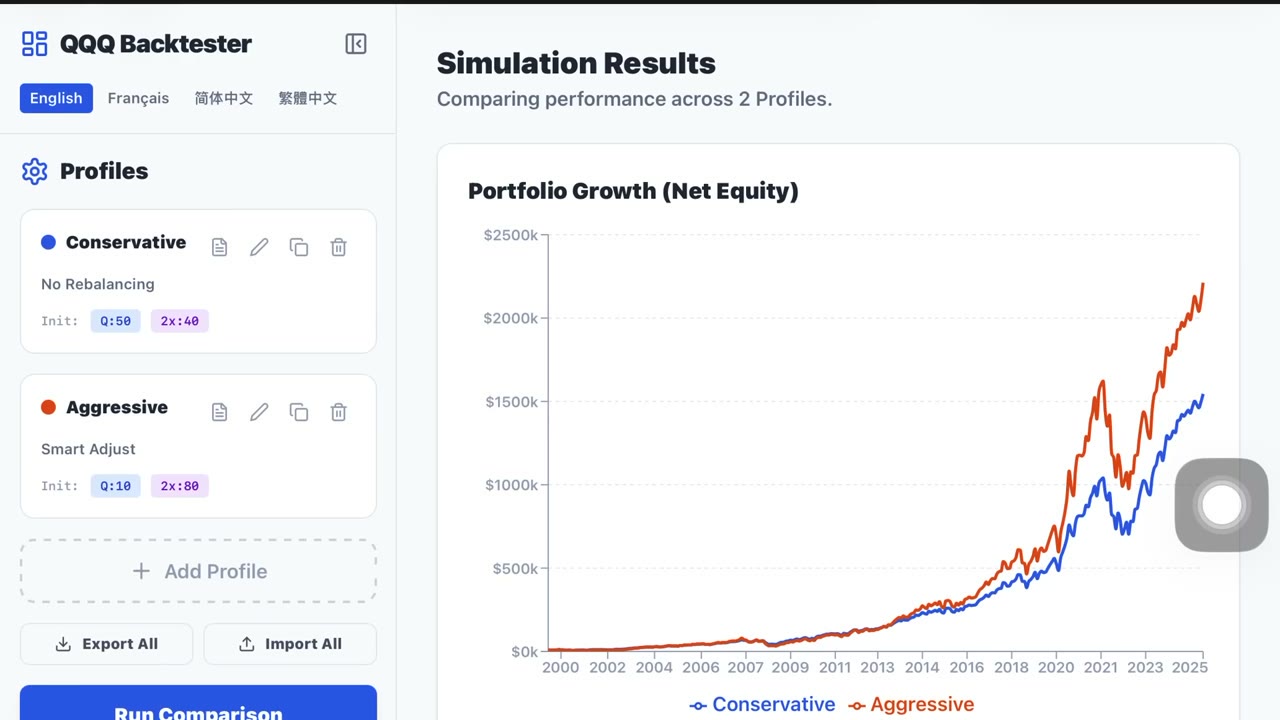
A practical walkthrough of the updated asset allocation backtesting tool, covering portfolio creation and duplication, rebalancing comparisons, result exports, cash-flow views, and household balance sheets.

Dec 30, 202528:56
CLEC Investment & WealthCLEC Investment & Wealth

CLEC content, long-term investing tools, and source materials for learning and independent review.

X (Twitter)Apple Podcasts
Tools
  • Start Here
  • Related
  • Investing Tools
  • Nasdaq-100 DCA Calculator
  • Asset Allocation Simulator
  • Global ETF Comparison
  • Global Nasdaq & S&P ETF Map
  • Mainland China U.S. Index QDII Comparison
  • QQQ returns by year
  • SPY returns by year
Resources
  • Blog
  • Documentation
  • Video
  • The CLEC Handbook
  • Database
About
  • About Us
  • Contact
  • FAQ
  • Waitlist
  • Changelog
  • Roadmap
Legal
  • Cookie Policy
  • Privacy Policy
  • Terms of Service
  • Disclaimer
  • Anti-Fraud Notice
© 2026 CLEC Investment & Wealth. All rights reserved.·Sitemap