CLEC Investment & WealthCLEC Investment & Wealth
  1. Home
  2. Video
  3. Topics
  4. Avoid Structured-Note Traps: Support Retirement with SCHD Dividends and Delay Social Security
Avoid Structured-Note Traps: Support Retirement with SCHD Dividends and Delay Social Security
Unable to play this video: Avoid Structured-Note Traps: Support Retirement with SCHD Dividends and Delay Social Security

Video information

00017

Avoid Structured-Note Traps: Support Retirement with SCHD Dividends and Delay Social Security

Using the case of an unemployed viewer nearing retirement, the video connects investment simplification, dividend cash flow, living costs, and delayed Social Security benefits.

Published
Oct 19, 2025
Total duration
5:43
Source
CLEC Investment & Wealth

Categories

  • Topics

Video Overview

The video begins with a letter from a viewer who is nearing retirement and has been unemployed for some time. Although the viewer holds cash, a complex financial product in a retirement account has lost value, creating pressure around work, living costs, and how to arrange available funds. The speaker first warns that attractive interest payments may obscure the risks of complex products. For this particular case, the speaker then proposes exiting the complex position, consolidating available funds, and using dividends from SCHD as a source of cash flow. The video goes on to suggest that covering living costs with this cash flow could give the viewer room to consider claiming Social Security benefits later. It concludes with a three-part framework: simplify investments, establish cash flow, and delay benefit claims. This is a summary of the video's discussion, not investment or tax advice.

Key Takeaways

  • The viewer in the case is nearing retirement and has been unemployed for some time while facing questions about cash, losses in a retirement account, and living costs.
  • The speaker argues that complex financial products may use appealing interest payments to mask risks that are difficult to see and favors simplifying the position.
  • For this case, the speaker proposes consolidating available funds into SCHD and attempting to use its dividend cash flow to cover roughly a year of living expenses.
  • The video links cash flow for living costs with a later Social Security claim, ending with a framework of simplification, cash flow, and delayed benefits.

Chapters

About 00:00:33 · A Retirement Letter and Financial Pressure

The video introduces an unemployed viewer nearing retirement whose cash, retirement-account loss, and living costs create a difficult financial situation.

About 00:01:44 · Risks Behind a Complex Product

The speaker criticizes complex financial products promoted with attractive interest and warns of less visible risks and restricted access to funds.

About 00:02:34 · Simplifying the Position and Creating Dividend Cash Flow

For the case discussed, the speaker proposes leaving the complex position, consolidating funds into SCHD, and using dividend income for living costs.

About 00:04:10 · The Idea of Claiming Benefits Later

The video suggests that cash flow covering living costs could give the viewer room to consider claiming Social Security benefits at a later time.

Related Topics

retirement financial planning, complex financial product risks, retirement account losses, SCHD, dividend cash flow, living-cost planning, Social Security benefits

This page was prepared with AI from selected portions of the video's audio to help readers understand the main topics. It may omit secondary material or contain transcription errors; the original video remains authoritative.


All Videos

More Videos

Why Non-U.S. Investors Should Consider UCITS ETFs for the Nasdaq-100
00049Jan 1, 2026

Why Non-U.S. Investors Should Consider UCITS ETFs for the Nasdaq-100

Topics

Why Non-U.S. Investors Should Consider UCITS ETFs for the Nasdaq-100

The video discusses U.S. estate-tax considerations for non-U.S. investors holding U.S.-domiciled ETFs, introduces the UCITS structure, compares EQQQ and CNDX, and walks through an international-broker example.

Jan 1, 20269:36
Retirement Withdrawals and QQQ Beyond Tech Stocks: Selling a Home and Going All In on QQQ vs. the Belief That Property Creates Wealth (English Audio)
00048Dec 30, 2025

Retirement Withdrawals and QQQ Beyond Tech Stocks: Selling a Home and Going All In on QQQ vs. the Belief That Property Creates Wealth (English Audio)

Topics

Retirement Withdrawals and QQQ Beyond Tech Stocks: Selling a Home and Going All In on QQQ vs. the Belief That Property Creates Wealth (English Audio)

The video asks whether QQQ should be viewed as a concentrated technology holding, then presents the speaker's views on long-term investing, a 2.5% retirement withdrawal threshold, and property versus liquid investments.

Dec 30, 20257:23
How to Use the Asset-Allocation Backtesting Software
00047Dec 30, 2025

How to Use the Asset-Allocation Backtesting Software

Topics

How to Use the Asset-Allocation Backtesting Software

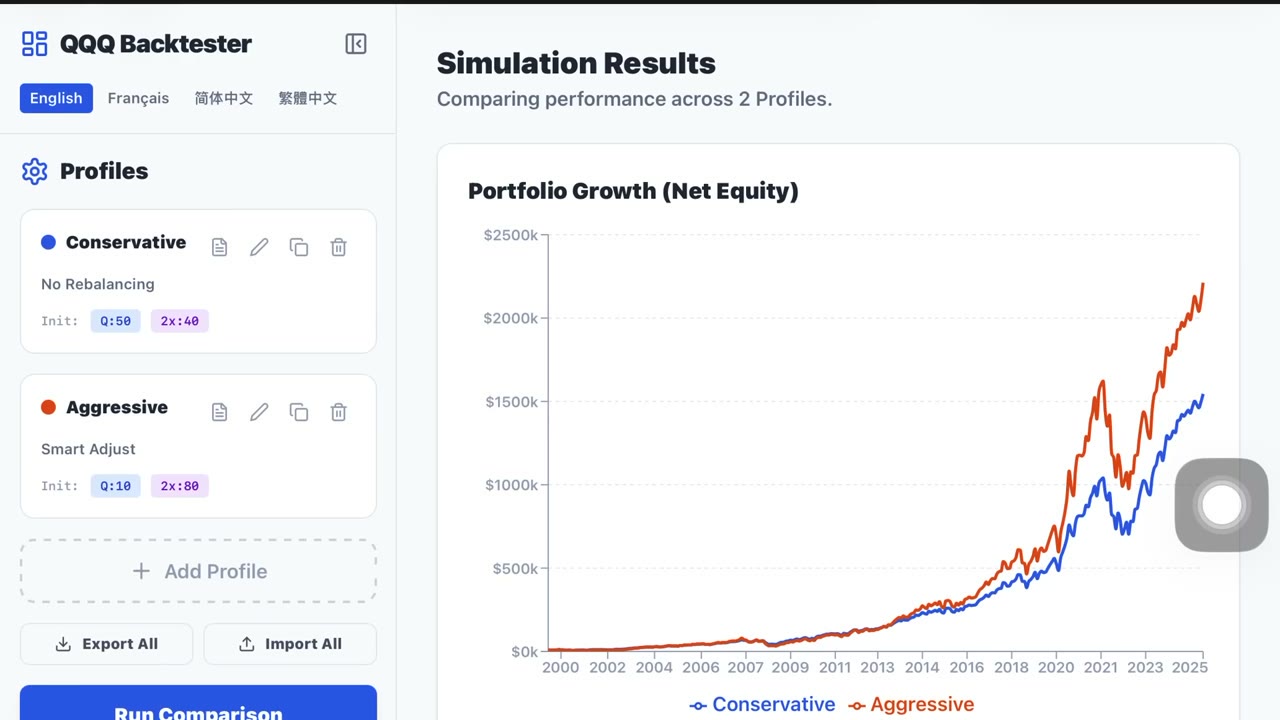
A practical walkthrough of the updated asset allocation backtesting tool, covering portfolio creation and duplication, rebalancing comparisons, result exports, cash-flow views, and household balance sheets.

Dec 30, 202528:56
CLEC Investment & WealthCLEC Investment & Wealth

CLEC content, long-term investing tools, and source materials for learning and independent review.

X (Twitter)Apple Podcasts
Tools
  • Start Here
  • Related
  • Investing Tools
  • Nasdaq-100 DCA Calculator
  • Asset Allocation Simulator
  • Global ETF Comparison
  • Global Nasdaq & S&P ETF Map
  • Mainland China U.S. Index QDII Comparison
  • QQQ returns by year
  • SPY returns by year
Resources
  • Blog
  • Documentation
  • Video
  • The CLEC Handbook
  • Database
About
  • About Us
  • Contact
  • FAQ
  • Waitlist
  • Changelog
  • Roadmap
Legal
  • Cookie Policy
  • Privacy Policy
  • Terms of Service
  • Disclaimer
  • Anti-Fraud Notice
© 2026 CLEC Investment & Wealth. All rights reserved.·Sitemap