Video Overview
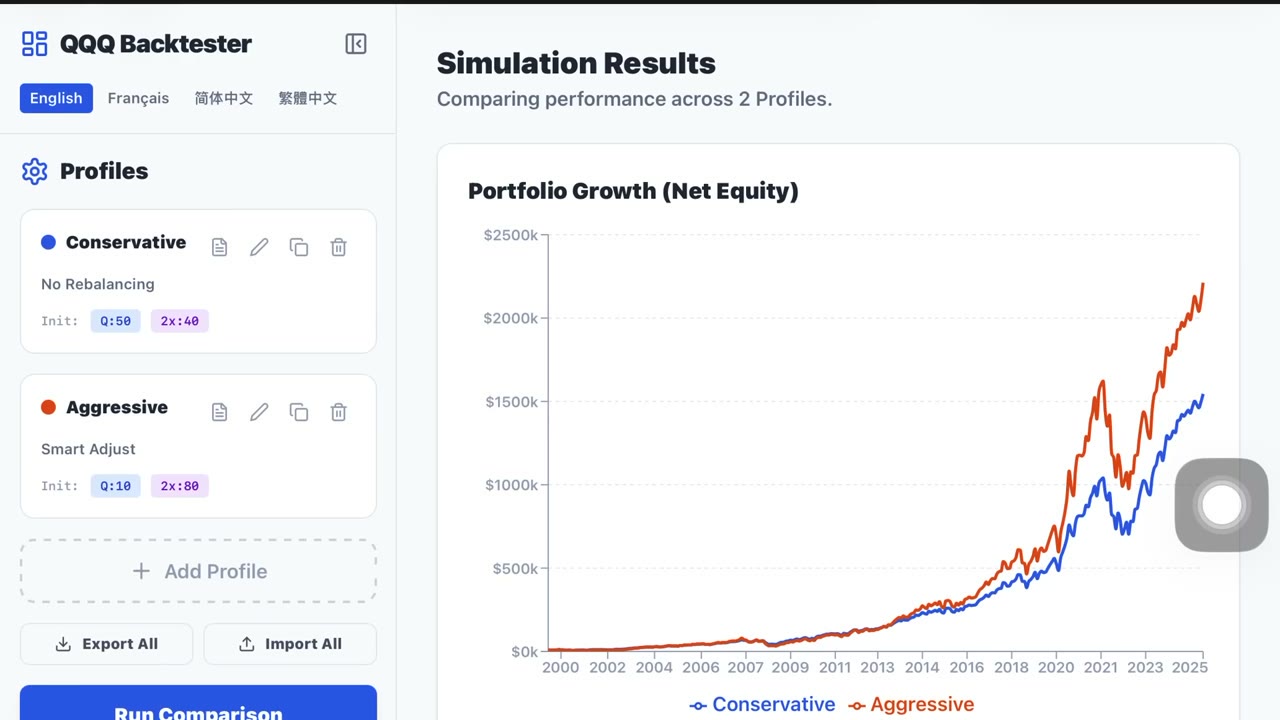
This video continues the walkthrough of an asset-allocation backtesting tool. The speaker first advises exporting a profile so that refreshing the page does not erase its settings, then imports a sample profile and compares six simulated scenarios. Under the video's own pass/fail rules, the speaker identifies annual borrowing or spending rates for Taiwan 433, U.S. 433, and unpledged 80/20 allocations before demonstrating settings for smart rebalancing, cash interest, loan rates, maintenance ratios, and LTV. The closing tests rerun the model with higher borrowing or monthly spending to identify failure cases. All percentages, product symbols, and outcomes are assumptions or results from the video's backtest; they do not predict future performance or constitute borrowing or investment advice from this site.
Key Takeaways
- The speaker advises saving or exporting the settings so a refresh does not erase them, then imports an existing Profile and runs six Taiwan, U.S., and unpledged allocation scenarios.
- Under the speaker's model rules, Taiwan 433, U.S. 433, and unpledged 80/20 scenarios pass at annual borrowing or spending rates of 2.5%, 2.1%, and 2.7%, respectively; these are model results only.
- One of the speaker's pass criteria is whether ending funds remain at or above the initial 1 million, illustrated by comparing 2.7% and 2.8% in the unpledged scenario.
- The setup uses smart rebalancing and the video's assumptions for rates, maintenance ratios, and LTV; 00865B, QQQ, SWVXX, and SGOV appear only as model inputs, and results change with those inputs.
Chapters
About 00:00:00 · Saving-settings reminder and six simulations
The speaker advises saving or exporting the settings, then imports an existing Profile and runs six simulations.
About 00:00:45 · Pass rates for the three scenario types
The model results associate 2.5%, 2.1%, and 2.7% with the Taiwan 433, U.S. 433, and unpledged 80/20 scenarios, respectively.
About 00:03:26 · Checking smart rebalancing settings
The speaker returns to the interface to verify the rebalancing method and confirm whether the Taiwan and U.S. simulations pass under the current settings.
About 00:04:59 · Taiwan and U.S. loan and LTV inputs
This section reviews cash interest, loan rates, maintenance ratios, and LTV for the two markets, including how the model combines collateral ratios for different products.
About 00:08:40 · Monthly spending and failure conditions
The closing example converts annual spending into monthly amounts, contrasts a 2.7% pass with a possible 2.8% failure, and explains the ending-asset test.
Related Topics
asset allocation backtesting tool, 433 portfolio, 80/20 asset allocation, securities-backed borrowing risk, smart rebalancing, LTV model settings, annual spending rate
This page was prepared with AI from selected portions of the video's audio to help readers understand the main topics. It may omit secondary material or contain transcription errors; the original video remains authoritative.