
Dispelling U.S. Decline Anxiety, "Don't Listen, Don't Look" Investing, U.S. Expat Tax Tips, and Setting Boundaries on Parents' Debt!
CLEC James Chat EP42: Addressing fears of U.S. decline, ignoring market noise, U.S. tax tips for Taiwanese expats, setting boundaries on parents' debt, and Roth conversion strategies.
Hello everyone, welcome to CLEC James Chat. I'm James.
Today should be Episode 42, and we have several topics to talk through.
Topic 1: If You Worry America Might Decline in the Future, Is It Still Worth Investing in U.S. Stocks?
First, a friend of ours has been sharing our videos and investment philosophy, though of course very few people can actually accept it. Someone pushed back, saying that America's long bull market over the past hundred-plus years was only because of U.S. dollar hegemony or this and that—coming up with all sorts of reasons to argue that it's just a short-term phenomenon, that nobody knows what the future holds, that maybe China will become stronger, or Taiwan will become stronger, or America will decline, so they have doubts about investing in it.
We really don't know what the future holds either. But if you doubt whether QQQ or the Nasdaq-100 Index might turn bad someday—asking, "What do we do if it goes bad one day?"—that question is just like saying: I'm afraid to ride in a car because what if it gets into a car accident someday? Or saying I won't fly on a plane because planes can crash, so I'll never take a flight again. I'll never leave the house because going outside carries huge risks, so I'm staying indoors forever. I won't eat because illness enters through the mouth—what if I get sick?
People worry way too much and tie themselves in knots, finding a thousand different ways to convince themselves "don't do this." The probability of America declining is probably lower than the probability of getting into a car accident. Even if you worry about America declining, that's something that would take hundreds of years to play out. Forget hundreds of years—even something 50 years from now: rather than worrying about what happens in 50 years, you'd be much more practical worrying about how many car accidents might happen in the next year.
Honestly, there's nothing much left to say about this kind of thing. When you don't want to accept something, you can come up with a thousand excuses. When you do want to accept something, you tell yourself it will never happen. Most people are actually very brave about plenty of other things—for example, buying a house: "Could the house catch fire? No way, I wouldn't be that unlucky." Or buying leveraged funds, piling leverage on top of leverage, being super brave about it: "No way, I wouldn't be unlucky enough for the market to drop 80%."
That's why we can never convince another person—only they can convince themselves. Usually, for something people want to do, they'll find a thousand reasons why it's fine; for something they don't want to do, they'll find a thousand reasons not to believe it. So whether America will decline, we truly don't know, yet in the short term—within five years—the odds of America collapsing are probably lower than getting into a car crash, maybe even lower than a plane falling out of the sky. If you're worried America will collapse within five or ten years, you probably shouldn't dare board a plane or even step outside your door. All right, we'll leave this topic there.
Topic 2: The Mindset for Market Volatility—"Don't Listen, Don't Look, Doesn't Exist"
The second thing we'll discuss is the market drop over the past few days. Some people who only recently found us say they bought right at the top and now watch the market fluctuate every single day—folks in Asia are even waking up in the middle of the night to check Nasdaq prices.
That just means they haven't truly learned the CLEC investment philosophy yet. The CLEC investment philosophy means you don't check stock prices, you don't watch the market, and you don't analyze anything at all. Whenever you have money, you buy immediately at market price, ignore the fluctuations, and check back in thirty or forty years. So the assets we invest in don't need to be watched, and they don't need to be managed.
If you're still working, just focus on having your paycheck come in and covering your living expenses, and whenever you have money left over, buy immediately at market price—that's all you need to do. You can keep working for 10 or 20 years and only then check how much your assets have grown. Short-term fluctuations over two or three years, or four or five years, have nothing to do with you—even if the market were to fall for 10 years, it still has nothing to do with you, because you won't need that money until more than 10 years from now.
If you're already retired, it's even simpler, because you have a withdrawal rate. We've taught how much you can withdraw based on your assets: once you have 33 times your annual expenses and proper asset allocation in place, you can draw 3% every year. You have money to spend each year, you spend as you wish, and knowing how much you can spend each year matters far more than watching the ups and downs in your account.
So that's our second topic: "Don't listen, don't look, doesn't exist." Even if the market falls for 10 years, you won't worry. Did you buy at the top? Some of your purchases will be at highs, and some will be at lows, right? Stop paying attention to outside noise—don't listen, don't look, doesn't exist. The more closely you follow the market, the harder it becomes to stay comfortable with your investments. We ignore market volatility completely; you only see the results thirty or forty years later. Fluctuations over a day or two, or even over a few years, are not what we should be worrying about. Buffett said investing is a lifelong endeavor—don't trade short-term, and don't watch short-term moves, OK?
Topic 3: Tax and Asset Planning for Taiwanese Expats Relocating to the U.S. (Such as in the Semiconductor Industry)
Here is another piece of information: many friends from Taiwan are being relocated to the United States nowadays, especially in the semiconductor industry. Some of them have already bought 00662 back in Taiwan, and once they're assigned to the U.S., they wonder how to handle their Taiwanese 00662 holdings and related matters.
When you're assigned to the U.S. and reside there for more than 183 days, you become a U.S. tax resident even if you don't have a green card yet, meaning you are taxed on your worldwide income. So if you're being relocated to the U.S., before you come over, it's best to sell your stocks and immediately buy them back so that you step up your cost basis first. For example, suppose your original cost basis in 00662—maybe it has already split—was say 10 dollars, and right now (I don't know what 00662 is trading at currently) you sell at 25 dollars and buy it right back; then your cost basis resets to 25 dollars. As far as the IRS is concerned, your cost basis is 25 dollars instead of the original 10 dollars, which keeps things much cleaner.
Once you arrive in the U.S. and become a U.S. tax resident, you don't need to worry either, because as long as you don't sell your 00662, there's no tax issue—you have no realized capital gains. Since there are no capital gains, nothing shows up on your U.S. tax return and you don't have to report anything in the capital gains section. Some people don't know whether after three years in the U.S. they'll move back to Taiwan or stay on in America—well, deal with that three years from now. As for your remaining assets in the U.S., you only need to report capital gains if you buy and sell; if you don't sell, you don't have to report them. Of course, your wage income still has to be reported.
Next, while you're in the U.S., TSMC and other companies offer a 401(k). For some of them, there's a 5% match on the traditional 401(k)—meaning if your annual salary is $400,000 and you contribute 5%, or $20,000, the company matches $20,000. If the company only matches contributions into the traditional retirement account, just contribute enough to capture the employer match and no more to the traditional side, then put the remaining room into a Roth 401(k). Max it out regardless of whether you plan to move back to Taiwan, because all future capital gains in there are tax-free. Even if you return to Taiwan, once you reach age 59½ and sell from your Roth account, there's zero tax.
If you later get a green card and remain a U.S. tax resident, you still owe no tax on your Taiwanese 00662 as long as you don't sell—you can use securities-backed loans to access cash when you need it. So your Taiwanese 00662 assets won't trigger tax issues as long as you don't sell them. In short, leave them untouched so the tax authorities have nothing to tax, and simply borrow against the shares when needed. As for estate planning, worry about that when the time comes—typically Taiwanese assets fall under Taiwan's estate tax rules and U.S. assets under U.S. estate tax rules, and that's that.
All right, that's a rough overview of this part... I'm not a tax professional, so take what's useful and otherwise consult a qualified specialist. Right now the maximum 401(k) contribution limit is $24,500—$24,500. And if you decide you don't want to stay a U.S. tax resident, don't want to remain in the U.S., and don't want a green card, and you move back to Taiwan after three years, at that point you can roll your 401(k) over into an IRA. Once it's rolled over into an IRA, you can also convert the traditional IRA portion into a Roth IRA. By then you'll probably have already left the U.S., so even when you file taxes on the conversion, your U.S. income will be very low.
Topic 4: When Parents Fall Into Scams and MLM Bottomless Pits, How Should Adult Children Protect Themselves?
Now, we received a letter today about a mother—or parents in general, whether mother or father—who lack financial literacy and keep getting scammed. For instance, co-signing loans for other people and ending up paying off others' debts; or wanting to earn extra money by joining some multi-level marketing scheme, except MLM requires paying money and buying inventory, so they mortgage or borrow against the family's scooter and car, pour that borrowed cash into the MLM business hoping to make more money, and end up losing even more and piling up huge debts; they even bought things like Lungyen columbarium niches and pre-need funeral contracts. People who have no money somehow always lose even more—the harder they try to make extra money, the deeper they sink into losses.
And of course the son wrote: "My brother and I are constantly paying off our parents' debts—paying, paying, and paying—yet whenever we try to talk sense into them, they refuse to listen. What should we do?"
What should you do? Your parents are a bottomless pit. You could pay off their debts forever and never reach the bottom. Honestly, your responsibility to your parents tops out at a warm meal and a bed—as long as they have a bed to sleep in and food to eat, that's enough. If they have nowhere to sleep and nothing to eat, you can provide a bed and a meal, just like with children. Nothing beyond that—every bit of their debt is theirs to repay.
The very reason their debts never end is precisely because you keep bailing them out. In their minds, whatever they borrow, their children will cover it; whenever they want to spend, they just borrow, spend it, and leave the bill to the kids. That is literally handing drugs to an addict—they will never be able to kick the habit. So let them stay in debt, let the banks or creditors come after them, and do not pay a cent. Even if it feels like it's tearing you apart, hold the line—only when they finally wake up is there any hope of saving the situation. If you never let them hit rock bottom and wake up, an addict will never come to their senses.
So don't rescue addicts, don't rescue gamblers, and don't rescue chronic debtors—you must draw that line clearly. Otherwise, you and your siblings will all get dragged underwater by your parents until the entire family sinks to the bottom of the ocean, losing both your parents and yourselves. You cannot let that happen. Everyone has to protect themselves first; only when you protect yourself can your loved ones have someone to lean on, otherwise everyone goes down together. That's unacceptable—you have to separate what belongs to whom. Your parents' debts are your parents' business. You have zero obligation to pay them off—none! You have no responsibility to repay their debts, remember that—none! If their bank accounts get frozen and they have no money left, fine—just hand them cash to buy lunchboxes to eat. It's that simple: keep them from starving, and nothing more.
Topic 5: U.S. Roth Conversion Strategy: Lump-Sum vs. Phased Conversions?
Next up is the question of Roth conversions. There's a basic principle here: if you're paying the conversion tax out of your own money, it's better not to convert too much at once—convert gradually in lower tax brackets. It also depends on your rate of return. If converting all at once pushes your marginal tax rate up to nearly 50%, compared with spreading the conversion over 20 years at a 34% or 35% tax rate, then starting with $3 million, a lump-sum conversion leaves you with $15 million after 20 years, whereas converting annually at the lower 35% tax rate leaves you with $21.5 million after 20 years—$6.4 million more than doing it all at once.
OK, that calculation assumes a 12% annualized return. There's another angle too: if you use a PAL (Pledged Asset Line) to pay the tax bill, then converting $3 million all at once means paying $1.43 million in taxes. Assuming your return can stay above 13%, then sure, doing it all at once—paying the tax and converting the full $3 million in one shot—comes out ahead; however, if your return is lower, converting all at once isn't as favorable, and converting gradually wins out. So the breakeven threshold sits at a 13% rate of return. (Note: the 13% threshold comes from a separate calculation based on a $500,000 starting balance, $60,000 converted per year over 40 years on an after-tax basis; Rosa's $3 million calculation assumed a 12% return.)
And that's only when paying the tax with a PAL. If you aren't using a PAL to pay the tax, then the earlier rule applies—converting gradually works out better. So take this as a reference. Even though converting $3 million all at once could come out ahead if returns exceed 13%, borrowing around $1.5 million—$1.43 million—at once introduces account risk and collateral risk: with a loan that large, if the market drops, couldn't you get hit with a margin call? That's the danger of borrowing a huge lump sum. So for most regular people, phasing the conversion in batches is still more advantageous and much safer.
Even if you do a lump-sum conversion, at a 13% return you still don't beat converting gradually; only when the return climbs above 13% does converting all at once come out ahead.
Closing and Key Takeaways
All right, so those are the topics we covered today:
-
First is "don't listen, don't look, doesn't exist." And if you're worried America will decline, you're probably better off worrying about getting into a car accident when you leave the house—the odds of a car crash are far higher than America collapsing.
-
Second, your parents' debts are for your parents to repay—they have nothing to do with you.
-
Also, for our friends in Taiwan's semiconductor industry, there are some key tax tips you should know when relocating to the U.S.
-
Finally, for Roth conversions in the U.S.—should you convert all at once or in batches? As a rule, converting gradually in batches won't leave you worse off. Unless you have huge PAL capacity so borrowing one or two million dollars at once to pay taxes won't push your account risk too high, and you can also sustain returns above 13%, only then might a lump-sum conversion make sense. In principle, 99.99% of people should simply convert in stages while staying in lower tax brackets.
All right, that wraps up today's sharing. Tomorrow is Friday—see you tomorrow, OK? Bye-bye.
Listen on Spotify
Author

Categories
More Posts
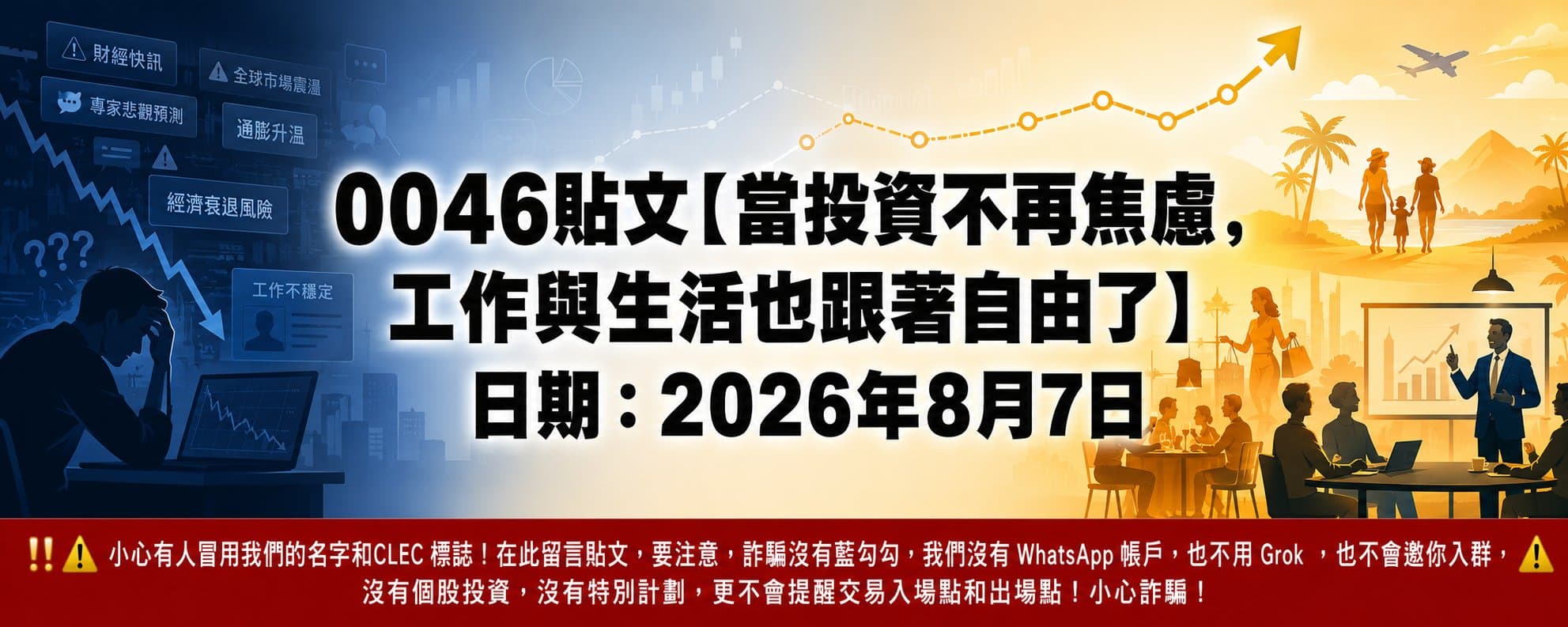
When Investing No Longer Causes Anxiety, Work and Life Become Freer Too
A student in mainland China explains how a simple long-term investing approach eased the family’s anxiety, made spending and work feel freer, and changed their outlook on life.
Buying Funds in Taiwan: Bank Fund Fees of 2%-3% Are Very Expensive, Plus Annual Custody Fees
The post lists preferred fund-buying channels in Taiwan, including Franklin Templeton and FundRich, to reduce transaction fees.
【When to Buy? from Common Stocks and Uncommon Profits】
【When to Buy? from Common Stocks and Uncommon Profits】CLEC Club Writing date: Feb 11, 2019 The core of successful investing lies in learning how to discover a small number of stocks whose earnings per share may grow amazingly over the next several years.
Newsletter
Join the community
Subscribe to our newsletter for the latest news and updates