
00090
Family Financial Planning Issues and Discussions
Short
Family Financial Planning Issues and Discussions
The video addresses a U.S. family's brokerage assets, pledged borrowing, taxes, living costs, Traditional 401(k)-to-Roth conversions, and college funding.
5:28

00089
Should the salary be placed in a general account to prepare for future pledges: or should it be placed in a ROTH retirement account?
Short
Should the salary be placed in a general account to prepare for future pledges: or should it be placed in a ROTH retirement account?
The video compares directing salary to a taxable brokerage account or a Roth retirement account, covering PAL collateral, liquidity, and leveraged-fund rebalancing.
4:24

00088
How to make capital investment decisions
Short
How to make capital investment decisions
The video addresses an annuity account and retirement funding, summarizing the speaker's views on emergency reserves, QQQ and SPY, spending multiples, and four allocation scenarios.
4:05
00451
The First Investing Lesson of 2024: An Investment-and-Life Lecture Valued at 100 Million (Multilingual Subtitles)
Long
The First Investing Lesson of 2024: An Investment-and-Life Lecture Valued at 100 Million (Multilingual Subtitles)
Talks and Q&A cover money, mindset, risk tolerance, stock questions, preparing for market declines and beginner execution challenges. Speaker and guest views are contextual, not site advice; read remarks in full context.
3:53:15

00087
If you don’t stay in individual stocks: the longer you stay, the more you will lose.
Short
If you don’t stay in individual stocks: the longer you stay, the more you will lose.
The video asks about the tax bill when a U.S. tax resident sells stocks to move into QQQ, covering the speaker's views on long-term capital gains, delayed sales, after-tax profit, and staged retirement sales.
2:23
00450
How much do you know about wealth: Exchange of money for index funds is real estate that will never be sold
Long
How much do you know about wealth: Exchange of money for index funds is real estate that will never be sold
Q&A on the speaker’s views of wealth, retirement accounts, estates, regular investing, leverage, and asset use, with tax context and borrowing warnings. Not investment, tax, or borrowing advice.
2:03:54

00086
Worry too much, live too little
Short
Worry too much, live too little
Beginning with the idea that excessive worry crowds out life in the present, the video uses a family's Japanese property, yen, education, and U.S. retirement questions to argue for acting on what can be decided now.
5:02
00449
The most valuable thing in life is beautiful memories: the most precious thing is time; the best thing is thinking
Long
The most valuable thing in life is beautiful memories: the most precious thing is time; the best thing is thinking
Opens with Buffett quotations on businesses, price, patience, and independent thinking, then covers borrowing, navigation, travel, family memories, time, and perspective—not personal investment or borrowing advice.
3:30:12

00085
Half of the lamb fell into the tiger's mouth in the financial industry
Short
Half of the lamb fell into the tiger's mouth in the financial industry
The video responds to a cross-border investor holding stocks, bonds, and a Treasury ETF, covering currency conversion, 00662, staged purchases, emergency reserves, and delayed securities-backed borrowing.
5:43

00084
What if all in QQQ or 00662 encounters the crash of 2000?
Short
What if all in QQQ or 00662 encounters the crash of 2000?
Addressing a viewer worried about investing in QQQ or 00662 at a market peak, the video presents four retirement allocations, withdrawal assumptions, income-loss scenarios, and lump-sum versus staged investing.
9:03
00003
Managing Traditional Retirement Accounts; from 3:11:00, the AI Industry Outlook and QQQ Growth
Topics
Managing Traditional Retirement Accounts; from 3:11:00, the AI Industry Outlook and QQQ Growth
Retirement-account conversions, Social Security timing, and inheritance questions lead into views on AI funding, QQQ turnover, infrastructure beneficiaries, and industry impact.
3:57:46
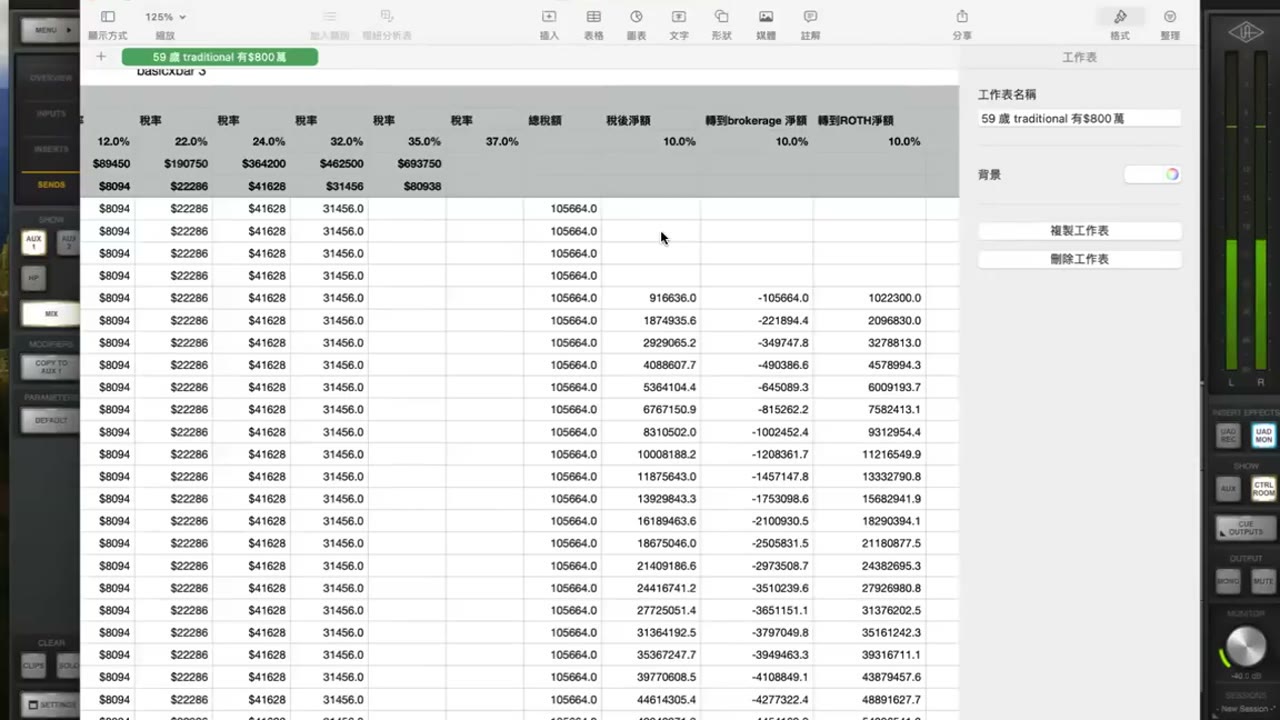
00002
Managing an 8 Million Traditional U.S. Retirement Account: Withdrawing About 11.5% and Converting 115,000 per Year from Each Million (Assuming 10% Annual Returns)
Topics
Managing an 8 Million Traditional U.S. Retirement Account: Withdrawing About 11.5% and Converting 115,000 per Year from Each Million (Assuming 10% Annual Returns)
Using a U.S. retirement worksheet and individual cases, the video discusses traditional accounts, former-employer 401(k)s, rollover IRAs, return assumptions, RMDs, switching costs, and worksheet access.
2:02:00